Making chocolate caramels

Chocolate caramels on Flickr

Buying a sugar thermometer seems like the sort of thing only crazy people do. It seems to sit along deep fat fryers and foam-generating siphons as the sort of equipment only professionals and obsessives really need.

The crucial thing about a sugar thermometer is that it allows you to measure a very simple property – the concentration of sugar in a syrup. That’s it.

Water  boils at 100°C (at sea level), and adding sugar to the water raises the boiling point up and up. Caramel is just very hot sugar, that has started to develop complex flavours, a little like browning meat. So a sugar thermometer makes caramel as well as jam a much more predictable affair, and removes much of the guesswork. I have both a glass thermometer, and a new and shiny digital thermopen. If using a glass one, be careful that you have enough liquid to immerse to the line it indicates, or the temperature won’t be accurate. You also need to make sure you put the thermometer in the pan early on – adding a cold thermometer to boiling caramel is a recipe for broken glass in your caramel. A good idea would be to warm the thermometer in the cream, then put into the caramel mixture once the cream is mixed in.

I like making caramel, because the ingredients are so simple and cheap: sugar, butter, cream – but the results are so complex in flavour. Depending on how long you cook this, and to what temperature, you can have a caramel sauce, soft, chewy caramels or hard toffee. I prefer a fairly soft caramel, that is still firm enough to slice and wrap.

These chocolate caramels are a beautiful combination of the buttery flavour of caramel with dark chocolate to balance the sweetness. I was surprised that the recipe asks you to cook the caramel with the chocolate in to a high temperature – I expected the chocolate to burn. I stirred fairly frequently to make sure it didn’t catch on the bottom of the pan, and there was no trace of burnt flavour in the caramel, so I guess it worked.

For more on regular caramels (without the chocolate), Dan Lepard has a great all-purpose caramel recipe he wrote for the Guardian a while back.

Salted chocolate caramels

Adapted from Smitten Kitchen, who in turn, adapted from Gourmet

Usually I would list the ingredients as I go, but it’s especially important to have everything prepared in advance for caramel making, so I have separated the preparation and cooking stages.

Preparation:

Line an 8 inch square pan with foil or two strips of baking parchment at right angles. If using foil, brush with a thin coating of vegetable oil. Set aside.

Chop:

150g dark chocolate

into small pieces and put into a heatproof bowl.

Place

240ml double cream

into a small pan.

200g granulated sugar

Put into a thick-bottomed pan, something quite tall as it will bubble up later (use your best pan for the sugar, and second best for the cream)

Measure out:

60g golden syrup

and

30g butter

and

1/2 tsp coarse sea salt, crushed into fairly small crystals

(this is optional, but very good. Maldon salt or fleur de sel is good. Table salt is not – it will be far too salty).

and put aside, near the stove.

Cooking:

Heat the cream until tiny bubbles start to form at the edge of the pan

Pour immediately over the chocolate, and stir gently until the chocolate is completely melted and the whole thing is smooth.

Add a tablespoon of water to the sugar in the pan, just enough to make it a little damp, and put over medium heat until the sugar dissolves. Keeping a lid on will help it heat faster, and make sure that the sugar gets dissolved properly. Once it is all clear and liquid, remove the lid, turn the heat up to high and boil furiously to make caramel. You want to bring it to a fairly dark amber, without burning it. When it starts to become golden, turn the heat down a little so you can control the process a little better.

Remove from the heat and add the golden syrup, and then, gradually,  the chocolate and cream ganache. Stir after each addition. It will bubble up furiously as the water in the cream is liberated to steam all at once – the caramel will be much hotter than the boiling point of water.

Once everything is combined, return to the heat with a sugar thermometer and bring to the boil again. Heat until the temperature reaches 255F/124C. Any lower, and you risk a pourable, liquid caramel (although if you want caramel sauce, that’s fine). You can take it higher, and get a firmer caramel, until it starts to become toffee.

Immediately remove from the heat, stir in the butter and the salt if using. Stir to incorporate the butter thoroughly, then pour into the prepared tin, and leave to cool and set.

Once completely cold, lift the caramel out of the pan with the paper or foil, and turn upside-down onto a cutting board. Use a large knife to slice into strips and then squares. Wrap each piece in a square of baking parchment or greaseproof paper. Or just eat quickly 🙂

Store in a sealed container – exposure to the air will allow the caramel to absorb water from the air, and it will start to become too sticky.

Mini chocolate walnut cookies

There’s something in the air about miniature desserts. Dan Lepard profiled mini-cakes in Sainsbury’s magazine last month. Yotam Ottolenghi wrote a piece for the Guardian‘s weekend food column on miniature financiers, mini cheesecakes, mini cookies. Could the mini-dessert become (gasp) the New Cupcake? (or the new whoopie pie, by now). But foolish food trends aside, there is something quite compelling about demolishing a little cookie or a baby cake, in its entirety.

Mini chocolate walnut cookie on Flickr

Although this might look large, this is an espresso cup and saucer.

It was this that attracted me to Heidi’s Itsy Bitsy chocolate chip cookies when they appeared on her blog. I returned to the recipe recently when I wanted to make some cookies, and only then remembered that I had adapted it to be almost a one-bowl recipe, if you have a food processor. If you don’t have one, you can head over to 101 Cookbooks, and Heidi has great instructions for making this by hand. But I love the simplicity of this method, combined with the cute-factor of the tiny cookies, and the amazing toasted flavour that comes from the walnuts and the crisp edges. These are not chewy chocolate chip cookies – they are crisp little discs, with a nubbly quality from the nuts and chocolate rubble – perhaps invoking a souped-up hobnob? They are flavourful, but not cloying; crisp but not too crumbly or greasy – ideal cookie jar-cookies in other words.

Mini chocolate walnut cookies:

(adapted from 101 Cookbooks’ Itsy Bitsy Chocolate Chip Cookies)

Preheat the oven to 180°C /160°C fan / 350°F.

  • 140g dark chocolate (I used Green & Blacks cooking chocolate, 72%, but something sweeter would also work)
  • 70g walnuts

–> Break the chocolate into pieces, add the walnuts and process to rubble in a food processor.

  • 140g wholewheat self-raising flour
  • 1/4 tsp bicarbonate of soda
  • 1/2 tsp salt

–> Add to processor with the nuts and process again to mix everything together, and grind the chocolate and nuts a little finer.

–> Empty the processor contents into a separate bowl (you’ll add them back later).  Add to this bowl:

  • 110g rolled oats

–> Add to the empty processor:

  • 110g butter, softened
  • 120g dark brown muscovado sugar
  • 120g caster sugar

–> Process together until fairly smooth and creamy. Add

  • 1 large egg
  • 1.5 tsp vanilla

–> and process again until smooth, scraping down the sides to make sure it is combined fairly evenly.

–> Return the chocolate, nuts and flour to the processor.

–> Process fairly briefly to mix everything together – you don’t want to overmix, or the gluten will start to develop and the cookies will get tough. Scrape down with a spatula to make sure there are no more floury patches.

Either refrigerate (for up to two days) or use immediately. Scoop off teaspoons of mixture, roll into a small ball, less than an inch across, flatten a little with a fork and bake at 180C/160C fan for 10-12 minutes, until slightly cracked around the edge and crisp. They will crisp up further as they cool.

[Refrigerating chocolate chip cookie dough is a NY Times recipe trick, attributed to Maury Rubin of City Bakery, and it does seem to develop a bit of extra flavour, but these are fine without it as well.]

Ribollita – robust vegetable soup

Ribollita ready for freezing

Ribollita is really just a robust vegetable soup, but the Italian name gives it an air of the exotic that plain old mixed veg doesn’t have. And it’s quite a plain thing, and even boring if not done carefully.

The essential elements are:

  • Onions, carrots and celery – a standard  soup or stock base, although I wouldn’t worry if you don’t have celery in the house.
  • Beans of some sort – a white bean like cannellini usually, but I have also subbed chickpeas in the past
  • Kale – usually cavolo nero, also called dinosaur kale which has long narrow green-black spears. You could instead use chard, regular kale, spinach, Brussels tops.
  • Even more starch – traditionally toasted bread is layered with the soupy part to make an almost sliceable bake. Skye Gingell’s innovation is to use farro (spelt), making it much more reheatable. You could probably use pearled barley to similar effect
  • Water

And that’s it. You may be thinking that this doesn’t sound very tasty so far, and I have some sympathy with that. Combined without care, it can be very dull. To make this work you need some patience and attention – not something I can always be relied on to provide. The vegetables need to be softened to extract and develop flavour before being swamped with water; you need a good amount of salt to season it properly, and some umami. Umami is the taste of savoury. It’s the flavour of glutamate, a type of amino acid, that is found in grilled meat, porcini mushrooms, parmesan, ketchup, soy sauce – almost anything that is used a condiment.

To get the umami flavour into the soup, using good stock helps, or just a stock cube, which are fully of precisely this flavour. Parmesan rinds (they freeze really well) cooked with the soup are very useful – the whole thing starts to smell of faintly of melted cheese, which can’t be a bad thing.

This soup, with perhaps a slice of bread, is a really filling lunch, freezes well and clears out pretty much your entire vegetable drawer in one go. What more could you want?

Ribollita

(adapted mainly from Skye Gingell’s ‘My Favourite Ingredients‘)

  • olive oil
  • 2 medium onions, chopped
  • 2 carrots, peeled and chopped
  • 2 sticks of celery, chopped
  • 3 garlic cloves, finely chopped
  • large pinch dried chilli flakes
  • 4-5 sage leaves, finely sliced
  • 2 medium potatoes, peeled and chopped
  • about 150g farro, rinsed
  • 1 can peeled plum tomatoes, chopped
  • 1 can cannellini beans (drained) – I used chickpeas because it was what i had in the house, but I think the creamy texture of the beans would have worked better
  • Chicken stock or water, around a litre
  • 1 bunch cavolo nero (or kale), thick stalks removed and roughly chopped
  • parmesan rinds (optional)

Heat olive oil in a casserole or large saucepan. Soften the onions over a medium heat. Add the carrots and celery, and fry gently for a few more minutes. (I tend to chop the onions before heating the pan, then just chop each vegetable as I go, adding to the pot, then moving on to chop the next one.) Add the garlic, sage and chilli and stir to fry and make fragrant. Add the potatoes, and farro, stir and heat again. Add the tomatoes and their juice, then add chicken stock or water to just cover the vegetables, and the parmesan rind, if using. Simmer for about 20 minutes until the potato and farro are cooked. Add the beans and the cavolo nero, and simmer for about another hour. Then either serve, or cool down, divide into portions and freeze.

The Great Brownie Bake-off

Saturday was a momentous day for me. My first piece of competitive baking – and my first win! Yes, my brownies were voted the best of 25 entries on Saturday at The Great Brownie Bake-off. I was amazed when I found out. Firstly, I was convinced I had underbaked them, so when my back started to give out on the day, I headed home a mere 20 minutes before the results were announced. And secondly because the judging panel included the amazing Paul A Young, as well as a host of other professional cake and chocolate experts.

If you’ve been here before, you’ll know that brownies have appeared before. I make them pretty regularly because they can be mixed quickly in one bowl, but the results still feel special enough for a celebration. So when Louise Thomas, The Chocolate Consultant announced that she was organising a brownie bake-off, I thought I would give it a go.

I started with my old recipe, which is a hybrid of a couple of versions in Alice Medrich’s book ‘Bittersweet‘ (one of my favourites) and gave it a few different tweaks to try it out on my work colleagues.
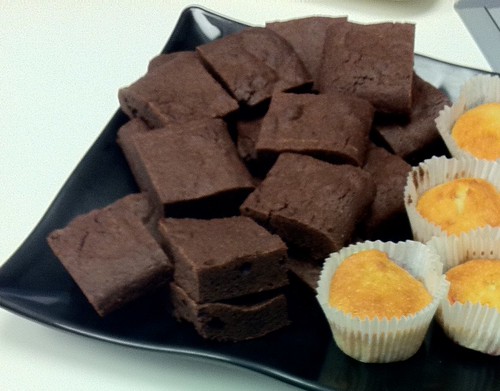
Brownies

I baked more for the Macmillan Coffee morning a couple of weeks later. These were tougher and overbaked, so I knew I had to do something different for the final version.

I went back to the drawing board to make the result softer and less dense. I toasted hazelnuts to give a subtle flavour compared to the more aggressive Frangelico or alcohol. Leon’s brownies include ground almonds which make them very gooey, so I ground some of the nuts to create the same effect. Finally, I replaced the caster sugar with some soft brown sugar and golden syrup for extra stickiness, and I hoped a little extra caramel flavour.

The bake-off was a great day, with demonstrations going on throughout the day. It was pretty packed though, so hard to get to the samples, and I wish I had muscled in a bit more firmly and introduced myself to more people.

Thanks so much to Louise for organising the day, all the judges: Paul A Young, Abigail Phillips, James Hoffmann, Tom Kevill-DaviesLee McCoy and Jennifer Earle, Jane MansonKavita Favelle and Mathilde Delville and Fred Ponnavoy from Gu Chocolate Puds.

Also lots of thanks to the demonstrators: Fred Ponnavoy, Caroline Aherne from Sugargrain Bakery, Edd Kimber, winner of the Great British Bake-off (and doing his first live demo!) Sasha Jenner from Hobbs House Bakery, and Stacie Stuart from Masterchef.

The Winning Recipe:

Ingredients

  • 100g unsalted butter
  • 100g dark chocolate(Valrhona Manjari 64%)
  • 30g Green & Blacks cocoa
  • 30g/2 tbsp Hazelnut chocolate spread (Nutella)
  • 100g light muscovado sugar
  • 85g caster sugar
  • 15g golden syrup
  • 2 large eggs, cold
  • 70g plain flour
  • pinch of salt
  • 150g whole hazelnuts

Method

  • Preheat the oven to 180ºC / 160ºC fan.
  • Toast the hazelnuts, by putting into the oven for 8 minutes. Rub off the skins.
  • Line an 18cm square tin with foil or baking parchment.
  • Put 35g of the toasted hazelnuts into a food processor and grind to a powder. Use some of the flour to prevent the mixture becoming too oily. Combine with the rest of the flour and set aside.
  • Combine the butter, cocoa, chocolate and chocolate spread. Melt in a microwave or in a pan on the stove until the butter and chocolate are completely melted and the whole thing is combined.
  • Stir in the sugars and golden syrup, then beat in the cold eggs one at a time until the mixture is glossy.
  • Add the flour and nut mixture and salt, and beat the mixture 40 times with a wooden spoon, until the mixture thickens slightly. Fold in the remaining whole hazelnuts.
  • Pour into the pan and bake at 180C/160C fan for 20-25 minutes, until it is cracked very slightly at the edges, but still soft in the centre.
  • To cut cleanly, put the cooled pan into the fridge, covered in cling film until thoroughly chilled or overnight. Remove the cold pan, invert over a board and peel off the foil or baking parchment. Cut into squares with a sharp knife.