Egg whites, meringues and macarons

Meringue

Updated: now with links updated

You can do so many things with even a small amount of egg white. As they are the best ingredient for capturing air, you can expand even a single egg white into a bowlful of foam. There’s nothing much to egg whites – they are just water plus some proteins. The part that makes them so useful is the properties of the protein. After it has uncoiled a little, it forms a network that traps air bubbles really well.

Keeping egg whites

Very few people outside the catering and restaurant industry seem to know how stable egg whites are. If you separate eggs and use the yolks, you can put the whites into a clean container, cover with cling film and store in the fridge for weeks, even months. You can also freeze them without any problem. Just be sure to defrost them carefully – you can easily cook them by accident if you microwave frozen egg whites!

Working with egg whites

Macarons - 2
There are a lot of legends surrounding egg whites. You do need to keep any fat away from them if you want to whip them up. That means that glass and metal bowls are best – plastic ones aren’t a good idea. Things that help: a little bit of acid works well – a couple of drops of lemon juice, or a pinch of cream of tartar. If you don’t do these things, the egg whites will still increase in volume, but won’t reach quite the same heights of stiff peaks.

Many recipes with whisked egg whites require stiff peaks. If you whisk too far, however, the egg whites will break up into little lumps as you fold them into something else. Both the acid and copper, if you use a copper bowl, will create a stable foam that takes longer to reach this pebbly stage.

When working egg whites into a thick batter, like a cake batter, you can use a portion of the egg whites to loosen the batter first. Just take a large spoonful of the egg whites and stir into the batter without worrying about the air. The liquid in the egg whites will loosen the batter enough to make it easier to fold in the rest and preserve the

Meringues

Adding sugar to egg whites stabilises the foam. Once sugar has been added to a meringue mixture, you can beat it for a long time, and it will just get stiffer. If you’re piping the meringue, or adding other ingredients (such as ground almonds for macarons de Paris), you want the mixture to be as stiff as possible so it will hold up when the other ingredients are mixed in. Meringues can be spooned or piped onto parchment paper for baking.

Meringues are intensely sweet, so it is nice to add a bitter or toasted flavour to contrast with it. Toasted nuts and caramel create complicated, toasted flavours that can make the perception of sweetness less acute, by making it less simple.
Coffee and brown sugar meringues temper the sweetness of white sugar. Adding a thick bland filling based on true buttercream, or perhaps on barely sweetened whipped cream, will also contrast with the sweet meringue.
I like an Alice Medrich recipe that combines dark chocolate, ground in a food processor, with stiff meringue. These are piped in small peaks and baked to give a crisp meringue cookie, with bursts of chocolate flavour.

Macarons
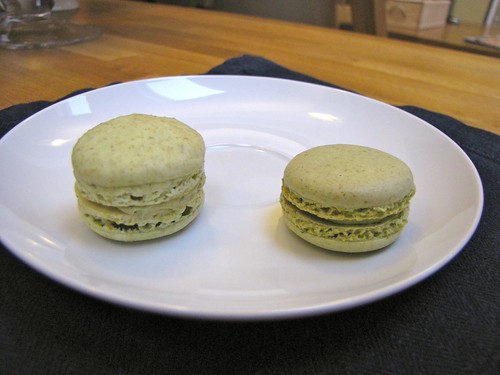
Pistachio macarons
Ms Humble has the best guide to macaron making – in a series of completely comprehensive posts, she goes through every possible hint and tip you could know about. (She also has awesome science cookies posts).
In my own experience, it can be hard to get the ideal shape and texture, but almost every macaron is worth eating, even those that don’t look too beautiful.

Pistachio macarons

You need to make a really thick meringue mixture, so it will hold after folding in the almonds, and while you’re piping. However, too much air will mean a more grainy surface and you won’t get such a smooth skin forming on the surface. You need to dry them a little before they are baked to get that smooth skin. Ms Humble has lots of ideas about the much harder task of getting something that’s crisp on the ouside, soft on the inside, and neither hollow nor sticking to the sheet.

(Below are a pistachio macaron from Alain Ducasse at the Dorchester on the left, and my attempt on the right).

More interiors

Coconut macaroons are much easier – you make a stiff mixture with them, cooking the mixture a little in the saucepan before spooning onto a baking sheet. Here, the sticking power of the protein is much more important than its foaming properties. David Lebovitz has a nice recipe for coconut macaroons.

Stock that’s clear

IMG_3790

It’s very seldom that you achieve the platonic ideal of stock. There is an idea of a clear, golden liquid that conveys many layered savoury depths, and brings a touch of magic wherever you use it,

Reams of cookery writers have written hymns to the power of stock. Anyone trained in the traditions of French cooking, from Joel Robuchon to Michael Ruhlman, will have learnt all about stock as the absolute foundation of French cuisine, the essential component of all meat cookery at least. But even home cooks like Nigella Lawson are converts to this idea.

I fall somewhere in between. I hate food waste, so the idea of extracting every last drop of flavour and nourishment from a chicken carcass really appeals to me. I follow Nigella’s suggestion of freezing chicken bones, and when I have two or three chickens worth, I put them all in a large pot of cold water, bring it to the boil, simmer for about an hour and a half, then add chopped onions, carrots, a stick or two of celery, a few peppercorns and bits of thyme and parsley if I have them around, and simmer for a further hour.

What this produces is fairly flavourful and good for soups and risottos. But it’s not what you think of as beautiful stock – the clear, golden liquid you might see in a consomme or tortellini in brodo.

I know that you should keep stock bubbling very slowly, but the importance of how slow this should be didn’t really sink in until I made ham stock for Heston’s pea and ham soup, using the recipe in Heston Blumenthal at Home. The recipe suggests that you cover the ham with water, add onions, carrots and leeks, bring to a simmer, then place in an 85C oven for 5 hours. This very slow, long cooking produces a liquid that stays well below boiling for the entire duration but still extracts deep flavours.

IMG_3783

When I took the ham out of the oven after this 5 hour stint, the liquid was so clear I could see all the way to the bottom of the pot. It helped that, to ensure the gammon wasn’t too salty, I had brought it to the boil, poured the water away, and then cover it with fresh water to make the stock. This helped remove the scum and bits of floating protein that will always accumulate when you boil raw meat.

A few days later, I rescued the bones from two especially fat pheasants we ate pot-roasted for New Year’s Eve from the freezer, and made stock from them. After the ham experience, I took the lid off, and after bringing it to the boil, kept the heat as low as possible. You can see the cooking in the (rather noisy) video below. It was barely possible to see a single bubble over the course of a minute. The reward for this was a beautiful, clear golden stock. I think this calls for a risotto.

Using stock

To really show off your stock, make risotto – this really captures the flavour you’ve painstakingly brought in. It also makes great soups (although water will almost always do, especially for vegetable soups), provides liquid for curries, gravy, bolognese sauces. If you’re going to make stock regularly (and if you eat roast chicken, it’s not difficult), don’t be precious about it. Use it whenever you see the opportunity. It’s silly to wait for a perfect risotto to use your stock, when you could use it to improve things, even just a little, throughout the week.

Making good stock

  • You don’t need the very best ingredients, but neither should you use only compost materials. Make sure the vegetables are clean, and that most of the skin and fat have been removed from the bones.
  • Stock is all about long and slow. Doing this in the oven is easier, but requires you to have an ovenproof pot with a lid big enough to make this work. Chicken bones want at least two hours, preferably three.
  • Either keep the vegetables in large pieces, and add them at the start, or chop them into chunks and add to the pot with an hour to go.
  • Strain through a fine sieve, or layer of damp cheesecloth to remove any particles. This also means you can add herbs and peppercorns straight to the pot without tieing them into a bundle.
  • Don’t season your stock. You might want to reduce it, so only add salt when you use the stock, not when you make it.
  • Reducing the stock will concentrate the flavour and make it easier to store. After you have strained it, pour back into a clean pot and boil fast to drive off water.
  • Stock freezes really well – it’s the best way to store it. Use either strong freezer bags, or rigid takeaway soup containers. With freezer bags, you can easily get small holes once the bag is frozen, so be sure to defrost it in a container, in case the bag leaks.

Using miso

Shiro miso

Miso is a fermented paste that is an essential part of Japanese cooking, but has also started to show up in recipes for everything from roast pork to soup to butterscotch sauce. I started reading about miso, and then picked up the bag of shiro (white) miso in the picture from The Japan Centre.  If you’ve had miso soup from somewhere like Wagamama, or even Pret, you have an idea of the sort of savoury flavour that comes from miso.

Making miso

While reading up about soy sauce, I came across this interesting idea:

“soy sauce and miso paste were originally the same
preparation, but the liquid became soy sauce, and the solids
left behind became miso”

Miso and soy sauce are both produced by fermentation. Miso can be produced by many different grains, but the most popular types are produced by soybeans with rice and/or barley, and some rice colonised by an Aspergillus fungus, called Koji.

Miso is has both savoury and sweet aspects. Both of these elements come about because the fermentation creates enzymes that break down both the starches and proteins in the soy and rice grains. Breaking down starch produces sugars, (starch is just the name for a long chain of sugar molecules joined together). Breaking down proteins produces amino acids for the same reason. Glutamate is the amino acid which creates the taste of umami.

Cooking with miso

Shiro miso paste

As I read more and more about miso, it became clear that there are a huge number of different types of miso, all with different characteristics. Still, the ones you are most likely to find easily in the UK are shiro miso, or white miso – a pale, fairly sweet miso; and aka miso or red miso, a more savoury and stronger paste. Both of these can be used to make miso soup, by combining them with dashi, a savoury stock made from dried kelp and dried bonito (tuna) flakes.

However, the sweet-savoury nature of miso makes it much more versatile. The current issue of Lucky Peach, an American food quarterly, includes a recipe for burnt miso butterscotch sauce and for miso mayonnaise. (You have to love a magazine that entitles an article on different types of miso paste ‘Miso Horny’. And if you don’t love that, then Lucky Peach is probably not the publication for you.)

You can use it to enhance the flavour of soup, to glaze steak or pork, to marinade salmon, or in salad dressing. It’s a flavour enhancer, which makes it very versatile. I’ll be trying to use more of it this year.

The recipe I started with was Smitten Kitchen’s Carrot and Miso soup. You can head over to her site for the details, but a summary of what I did is below. This is a great way to introduce yourself to miso. The carrot soup is fine without the miso, but with it you get a rounder flavour that brings together the sweet and vegetal tastes of the carrots.

Carrot and miso soup

Carrot and miso soup

  • Chop two small onions, a couple of garlic cloves and about 10 medium carrots.
  • Cook gently in olive oil until the onion is translucent.
  • Add a thumb-sized piece of ginger, chopped finely. Submerge everything in about a litre of Marigold vegetable bouillon (made weak so it’s not too salty). Simmer until the carrots are soft.
  • Blend in the pan with an immersion blender.
  • Take a ladleful of the pureed soup out into a small bowl, and mix in a couple of tablespoons of white miso. As soon as you mix the miso with the hot soup, you get a burst of that miso soup smell. Mix the soup back in and taste. If it needs more miso, repeat this procedure.
  • Serve with a few dots of toasted sesame oil on top.

Eating the soup