Friday food links – 27 Nov 2015

#latergram of the chocolate pavlova from Sunday lunch 😋

A week of holiday, away at Center Parcs means not much cooking. I brought a stack of ready meals (Charlie Bigham), and supplemented by my mother-in-law, we’ve brought enough food to last the week in our little lodge.
The amusements here are relatively basic if you’re 18 months old, but fortunately, at this age, you don’t need much to amuse you. Some time in the swimming pool, a few walks and the novelty of riding in a cycle trailer are all very diverting. And a mere three DVDs, plus a stack of books and a teddy bear are enough to occupy the dark and rainy hours.

Before we went away, we had our final all-comers Sunday lunch of the year. As we were catering for a gluten-free guest, I made two small modifications – using rice and potato flour to thicken a slow-cooker beef shin stew, and making a pavlova rather than a tart or cake for dessert – pretty undetectable modifications. The pavlova in particular was a great choice – a Nigella recipe for a dark chocolate, chewy meringue, topped only with whipped cream and raspberries. My daughter just wanted to pick the raspberries off the top, and demanded that someone else remove the cream from them. Sometimes I’m not sure that we are related.

Recipes:

  • Slow-cooker beef shin stew – I flitted between recipes for this, but eventually based it on the beef shin recipe in Slow Cooked, with some Boeuf Bourguignon twists: I substituted the beer with a mixture of red wine and beef stock. And after it had cooked overnight, I strained out the meat and vegetables, and reduced the sauce with a bit of potato flour to thicken it further. I added this back to the meat, along with some sautéed mushrooms, some browned pancetta, and a few sautéed shallots. This then had another hour in the oven just before it was served.
  • Hasselback potato gratin from Serious Eats – I couldn’t quite bring myself to make the full cheese-and-cream version, so mixed cream and milk to coat the potatoes, then added the remains of the beef stock to the bottom of the dish before baking. It probably could have used some extra butter on top to make the tops properly crispy, but was pretty good nonetheless, and much easier than the traditional version of layering.
  • Chocolate raspberry pavlova – from Nigella’s ‘Forever Summer
  • Dark Banana ginger bread – using up the browning bananas before we left on holiday. This is an old Dan Lepard recipe, super-simple to make, but with a good flavour. I added the zest of a clementine and a teaspoon of mixed spice as well.

Without a recipe:

  • Pasta with tomatoes, with bolognese
  • Various ready meals: Charlie Bigham fish pie, chicken and mushroom pies, lasagne. Donated sausage casserole and cottage pie (thanks, Chris!)
  • Cheese and ham quesadillas

Reading:

Devouring this book on holiday this week. Ruth Reichl (and @nigellalawson) write my favourite food prose.

I’ve spent much of the week engrossed in Ruth Reichl’s new book, ‘My Kitchen Year: 136 Recipes That Saved My Life’. Ruth is one of my favourite food writers, but she’s not very well known in the UK. She was a restaurant critic for the LA Times and New York Times, then editor of iconic American food magazine ‘Gourmet’ until it was shut down by Conde Nast in 20xx. This book is about the year after she lost her job, and the healing power of getting into the kitchen. Much like Nigel Slater’s recent books, it’s organised into seasons, and has a story with each recipe of what she was doing at the time. I’ve already bookmarked a stack of recipes to make, including Venetian pork (little pieces of sticky pork ribs), her basic chilli, diva grilled cheese, gingered applesauce cake with caramel glaze and Big New York cheesecake.

Other reading:

And if none of that is your thing, Sali Hughes has her beauty gift guide out too.
Book review: Slow cooked by Miss South

  
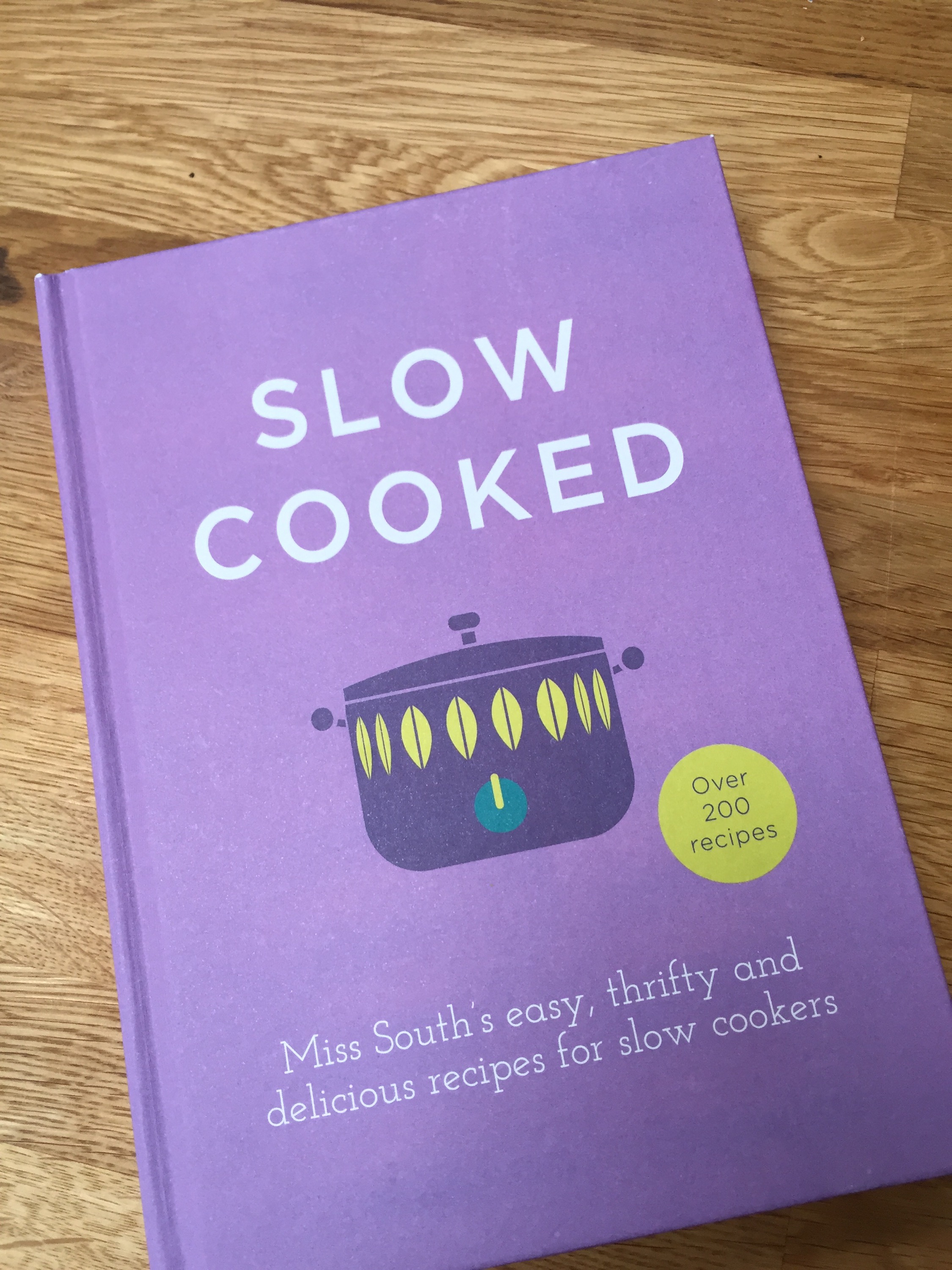
You may have noticed me going on (and on) about my slow cooker cooking in my weekly Friday food links posts. Faced with an imminent return to work, and the prospect of squeezing dinner preparation for a one year old into a tiny gap between nursery pickup and bath-and-bedtime, I decided a slow cooker would solve all my problems. (Well, maybe not all of them.) Aware of how little spare counterspace I have, as well as the number of appliances in my cupboards, my hand paused over the ‘buy’ button a couple of times, but in the end I went for it. I thought I had best get a book to go with this new purchase, and the briefest of searches through Amazon reviews suggested that ‘Slow Cooked‘ by Miss South of the North/South Food blog was the one to get.

In this instance, Amazon reviewers were right on the money. This is a great book, and I haven’t stopped cooking from it since it arrived. It has only a handful of photos, in a section at the start, but Miss South writes such excellent head notes that I have scarcely missed them. The recipe titles and notes are enough to draw me in.

I had expected a book largely filled with stews of various sorts – and would have been content with this. But she goes well beyond standard slow cooker fare, with chapters on currys, pulses and grains, vegetables, as well as cakes and breads, and puddings.


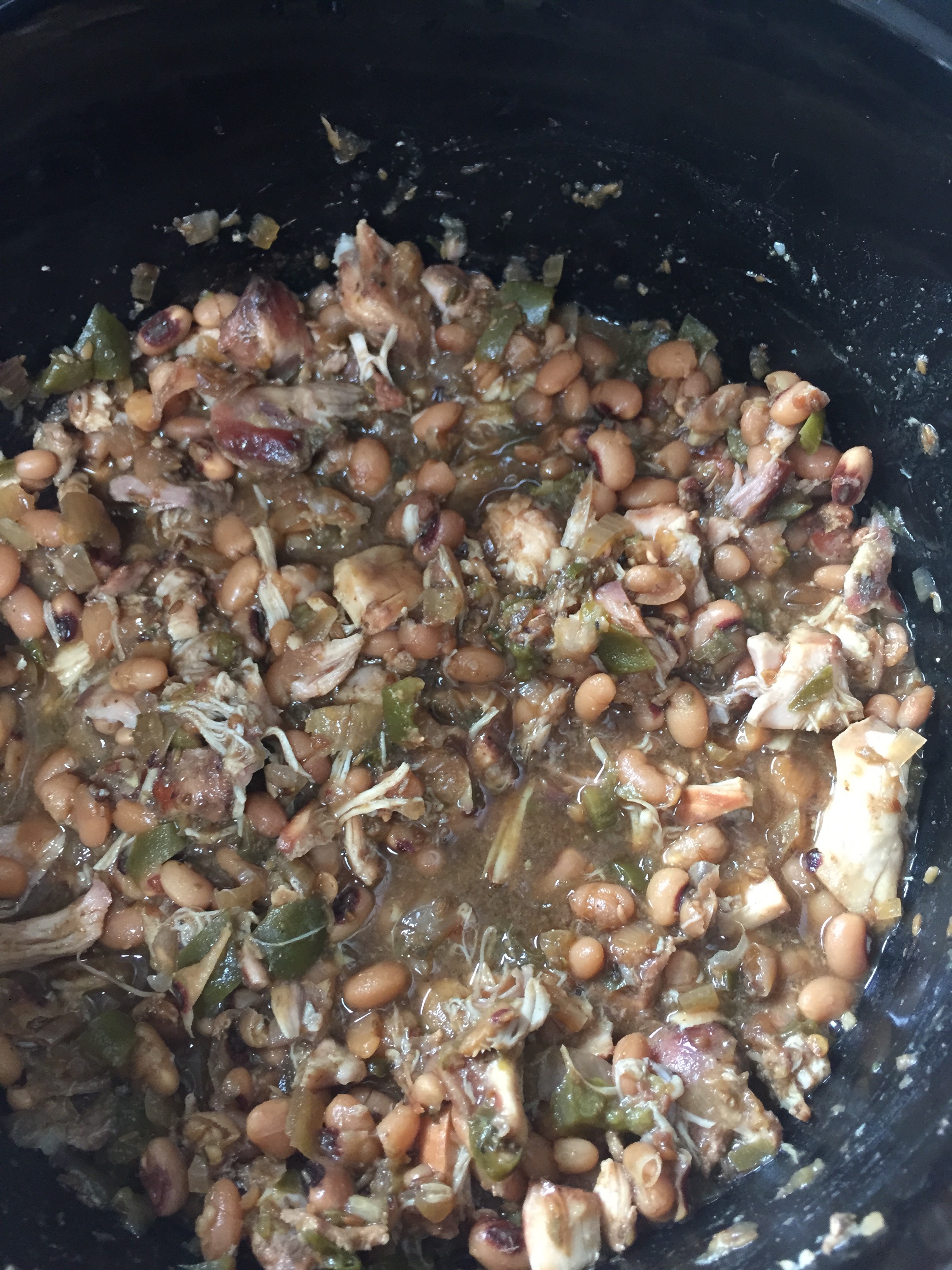
white chili

white chili with chicken and haricot beans

 
So far I have made: meat ragu, stewed beef shin, white chili, chicken mole, pulled pork, aubergine ragout, tarka dal, dulce de leche (heating a can of condensed milk), caramelised onions (a big batch for the freezer), chicken stock and confit tomatoes. Everything has worked, and has tasted good. The chicken recipes benefit from a slightly shorter cooking time – although the white chili makes good use of this by breaking up the chicken into shreds with the beans. The dal took longer, but I suspect the age of the split peas was to blame there. The beans in the chili, cooked from dried without soaking, were beautifully creamy and intact, with none of the fuzziness that comes from boiling.

There are still a lot more recipes I’d like to try out, not least the cinnamon buns, so, thanks to this book, I think my slow cooker has earned a permanent place on my counter.

Friday food links (cookbook edition) – 2 Jan 2015

The Christmas cookbook haul #excessive

I thought I would use this New Year post to make some notes on the new cookbooks I got for Christmas, and to remind myself of the recipes I’m most excited about making:

Patisserie Made Simple – Edd Kimber

This is the third book from the winner of the first series of Great British Bake off. I was interested in his claim to make french patisserie more straightforward, using everyday ingredients and equipment wherever possible. So far, it looks like it has a nice balance of the traditional and new interpretations with original flavours.

Bookmarked recipe: Simple Croissant Dough

Honey & Co– Sarit Packer and Itamar Srulovich

This is the book from the restaurant of the same name near Warren Street. I haven’t been yet, not having been to many restaurants in the last year, but have heard many glowing reviews. The food is middle eastern, with lots of israeli and lebanese touchstones. The writing is also lovely – welcoming and honest: “we hired Carlos, a sweet, funny Catalan who was the worst porter we’ve worked with”; “With all the tension that comes with restaurant life, this is one issue we thought we could do without, and so we decided to avoid the subject altogether and not serve hummus at all.”

Bookmarked recipe: so many – and I’m not even halfway through yet, but feta and spring onion bouikos are on the list, for the header note alone.

All About Braising Molly Stevens

This is an older book that I have read US bloggers rave about before. My sister evinced scepticism that braising was a subject that needed a whole book. While it’s true that the basic rules of braising are easy to grasp, getting a really well balanced braise is very tricky. I’m also interested to try some of the vegetable and fish braises in this book.

Bookmarked recipe: The very first one in the book was the first that caught my eye: braised potatoes with garlic and olive oil. It sounds basic, but I’ve never cooked potatoes like this before, and I’m interested to try it. Whole chicken braised with pears and rosemary runs it a close second.

Mast Brothers Chocolate Rick Mast and Michael Mast

The Mast Brothers look like archetypal Brooklyn hipsters, because they are. In a little factory in Brooklyn, they grind cocoa beans and produce powerful, fruity chocolate bars, wrapped in beautifully designed paper wrappers. This book has lots of very chocolatey recipes, but also lots of their story and how they source their beans and make their chocolate – they are very particular. [Note: I think this is my sixth chocolate cookbook. I may have a problem.]

Bookmarked recipe: Chocolate gingersnaps

The Trifle Bowl and Other Tales Lindsay Bareham

I’m not yet sure about this one. I has been on my list for ages, and Lindsay Bareham, like Molly Stevens, has the authoritative tone of someone who has cooked these dishes over and over and knows them inside out. This book is a compilation of some of her favourites, organised by the type of equipment used to make them – the trifle bowl, the cast iron casserole, the mandoline. Although I’m not yet convinced that this conceit works, I love the header notes, and the sense of her passing on well-worn tips and tricks.

Bookmarked recipe: Spinach malfatti, for a trick she passes on from the River Cafe of shaping the delicate dough by swirling it in a wine glass.

Plenty More Yotam Ottolenghi

This has had so much coverage, partly because of Yotam Ottolenghi’s celebrity status. The photography is the first thing that grabs you – page after page of rainbow-coloured vegetables, beautiful, mouth-watering dishes. Cooking from this is a given.

Bookmarked recipe: Beetroot, avocado and pea salad, for the beautiful contrast between the beetroot and red onion with the avocado, lambs lettuce and peas.

Brilliant Bread James Morton

This is another book from a Great British Bake Off contestant. I took it out of the library earlier in the year, and I find James’ scientific approach very appealing. He has a new book out this year on how baking works, which I’m looking forward to.

Bookmarked recipe: Tea loaf

Persiana Sabrina Ghayour

Sabrina Ghayour has rightly become something of a food star in the last year. This book is one of those where I whisked through, sticking a post-it on every other page. I already have a lot of middle eastern books, including Claudia Roden’s, but there is something fresh and easy about these recipes that makes it very approachable. I already feel like I’m going to cook a lot from this book this year.

Bookmarked recipe: Spice-perfumed shoulder of lamb I made this for New Year’s eve with a half-shoulder, which was just right for two. A mixture of rose petals, sumac, cinnamon and cumin is spread over the lamb before slow roasting. It’s both exotic and simple.

Konditor & Cook Gerhard Jenne

There is a Konditor and Cook shop perilously close to my office. Their curly whirly cake is my favourite choice for a comfort-eating treat, and they do great lunches as well. This book compiles their greatest hits from the London shops, with tips from the bakery.

Bookmarked recipe: Sunken pear and black gingerbread cake, as well as the more obvious Curly Whirly brownies.

One Good Dish David Tanis

I have David Tanis’s ‘A Platter of Figs’ and find his style very appealing, if not always achievable. He cooks at Chez Panisse, and is steeped in that California style of cooking that leans on the best, freshest produce, always seasonal and local. There’s no such thing as a ‘hungry gap’ in California, as far as I can tell. This book has lots of very simple, pared back dishes, some to the point of absurdity (garlic toast). But he has a way of putting together simple flavours that is just right.

Bookmarked recipe: Very green fish stew, a coconut-and-lime stew, loaded with fresh herbs.

Other people’s cookbooks

Books from blogs

Some of my favourite cookbooks by bloggers

One of the things I love about the web, and about twitter and food blogs in particular, is the vicarious friends you make. I get to know people so well through their writing and the little details of their lives, that when they do something big, like publish a cookbook, I want to buy it just to show my support. I’ve found myself doing this more and more in recent years. It started with Clotilde and Chocolate & Zucchini. The came Molly from Orangette and her book ‘A Homemade Life‘. The Smitten Kitchen Cookbook is probably my favourite of the year so far, and were it not for  blogs, I wouldn’t have discovered Jenny Rosenstrach and Dinner: A Love Story (not to mention her transformative pork Ragu recipe).

Jennifer Perillo and Shauna James Ahern, a.k.a. In Jennie’s Kitchen and Gluten Free Girl, are writers I only discovered in the last couple of years, although both have been writing for much longer.

Jennifer I found, like many others, when the food blogging world reached out after the sudden death of her husband Mikey. Her writing at that time was utterly compelling, full of exposed emotions and tenderness. She has written ‘Homemade with Love‘ about their family and the food they love.

Shauna I had heard of many times – she is so well-loved by other food bloggers – but I think I had assumed (wrongly) that because she was writing gluten-free recipes, it wasn’t for me. How completely wrong I was. Her latest book is ‘Gluten-Free Girl Every Day‘, about cooking for and with her family too – her chef husband and her daughter.

Both have recently written about their books and had friends make a short video as a book trailer. And both videos really convey a sense of what you expect these people to be like if you read them regularly: Jennifer, the strong, proud mama who surfaces what’s on her mind, no matter how emotional, and who is there for her girls. Someone who will tell you the story of the recipe and make you care about it. Shauna, the happy, capable mum who just wants things to taste delicious and wants to enjoy the simple things. I love that these videos give me a chance to ‘meet’ both of these writers, and figure out a little more about them.

Check out both of these posts – and see if you don’t want to cheer them both on too. Both of these books are now on my wishlist.

http://glutenfreegirl.com/2013/04/here-it-is/

http://www.injennieskitchen.com/2013/04/why-we-cook-food-curate/

Eliza Acton – Victorian recipe creator

IMG_1481

Never mind Mrs Beeton, Eliza Acton was the real force behind the modernisation and codification of the English Victorian kitchen. In fact, she moans in the preface to the revised version of her book, ‘Modern Cookery for private families’ that many people have been stealing her recipes, and she has taken great pains to note where the recipe is original to the Author, so that people may know these have been stolen from her when they appear in other texts. This is a not-so-oblique reference to Mrs Beeton, and others, who took her recipes for their own text. At more than 600 closely-typed pages, it is a comprehensive work, although unlike Mrs Beeton’s volume, it is restricted to cooking, and doesn’t deal with other areas of household economy like illnesses and servants.

She was among the first to list ingredients separately to the method, and to give reasonably clear instructions of how to make the dishes, without assuming very much previous knowledge of the cook. She apologises that the detailed explanations and observations she has given for each recipe mean that she can’t fit in as many recipes as other books can. Despite this, she fits in hundreds of recipes in the 34 chapters of the book, covering areas as diverse as Forcemeats, Curries, Pickles, Confectionary and Bread. In my calendar of cookbooks for this year, February’s allocation was Eliza Acton’s ‘Modern Cookery for Private Families’, first published in 1845, and reprinted by Quadrille as one of their ‘Classic Voices in Food’. Although one thing and another means I haven’t made anything from it yet, I’ve enjoyed browsing through it, and thought I would share some of my impressions.

Victorians had some funny ideas about health and eating, but Eliza Acton was ahead of her time in many respects. She thought home-prepared food that was nourishing was essential to be productive at work and to build health. She didn’t like the adulteration that was so common in those decades, and thought it important that every household knew how to prepare simple, economical dishes, rather than having to buy them in. She liked French cooking, plain English dishes, Indian curries, Jewish meals and included recipes for them all.

Although the popular caricature of Victorian cooking is a passion for boiling vegetables until they are thoroughly soft to make them more digestible, Eliza Acton does not seem to advocate boiling everything to death. She is often at pains to say that meat should be heated very gently. A recipe for buttered carrots advises that the carrots can be sliced and then boiled, or cooked whole before being sliced – the latter being the slower method, but the one that best preserves the flavour. I am intrigued to try this method.

Lemons are threaded throughout the book’s recipes, often added to butters and sauces, as well as zest being used in forcemeats and wherever breadcrumbs are needed. Likewise, herbs, particularly chopped parsley, are often used in quantity. This gives an impression of a much livelier cuisine that we are used to thinking of. It perhaps also conveys some of the French sensibility which was thought of as the height of sophisticated cuisine, and which Eliza observed first-hand while living in France.

Breadcrumbs are employed all over the place. A delicious sounding recipe for roast chicken calls for the bird to be stuffed with a basic forcemeat (flavoured breadcrumbs), then drizzled with butter and coated with breadcrumbs. This sounds like an early version of crispy fried chicken. She notes that gravy should not be poured over the bird when it is prepared in this way – too right.

Forcemeats play an important role in many recipes. I always thought of these as being based on sausagemeat or pork, but of course, it just means stuffing. The most basic versions in the book contain simply breadcrumbs, lemon zest, butter, and herbs. Some add pounded ham, oysters or mushrooms.

An absence I noted is that there are very few recipes for minced meats. Modern cookery handbooks would lean heavily on the packet of minced beef to produce pies, chillis, pasta sauce and so forth. The only recipe for minced beef appears to be those for ‘collops’, where it is cooked in a little gravy. There is a leftover beef pie, where the cooked meat (“that which is least done is best for the purpose”) is chopped, seasoned, mixed with gravy and topped with an “inch-thick layer of bread-crumbs” moistened with plenty of clarified butter. Sounds pretty good, and not unlike a cottage pie.

Eliza Acton - cakes

The thing I found odd when looking through the text was that there were relatively few recipes for cakes compared to modern texts. Perhaps not too surprising given that sugar was only just becoming affordable for everyday use. There was a major tradition of puddings, and of yeasted buns and breads with dried fruit. But cakes as we think of them don’t have much space devoted to them.

Cakes like fruit cake or Dundee cake that we think of as being very old English recipes are actually more recent. They rely on imported sugar, being produced in Caribbean plantations by slaves, as well as imported dried fruits and spices that would be unloaded at docks like those in London where you can still find traces of those imports in the street names.

A pound cake made with huge quantities of butter and eggs as well as sugar, and with a great deal of manual labour, was a real luxury product. Imagine making a fruit cake where you had to remove seeds and stalks, and wash and dry the raisins. Where you had to break down the sugar loaf into a powder before you could combine it. Where you might want to dry the flour out in a low oven to ensure it wasn’t carrying a lot of water that might throw off the weight. The amount of effort needed, never mind the cost, made sure this was firmly into special treat territory.

I wanted to make some spiced, fruited buns from Eliza Acton, but her recipe is so completely vague, it seemed impossible. In the end, I went instead for Elizabeth David’s in ‘English Bread and Yeast Cookery‘. The results from that are coming in another post soon.

Cookbook exploring in 2012

IMG_3777

I have acquired a lot of new cookbooks this year. A lot. In fact, I’ve just counted 24 new books in 2011, including both cookbooks and food writing. Gulp. One of the problems with twitter is that I feel connected to the food writers I follow, and so I feel more or less compelled to buy their books when they come out. It’s like buying the book your friend wrote – it just feels like something you should do to support them. Of course, I don’t know these people personally, but I feel some of that obligation nonetheless. This is not helping my shelf capacity.

Like most people, I haven’t made most of the recipes in most of the books I own – and my habit of constantly acquiring new ones isn’t helping. So I’ve decided to pick a book a month to cook from this year (except December). I’m hoping this will ensure I spend some time really exploring each of these books. It can also be helpful to restrict your choices sometimes. When I’m short of time, I’m much more likely to choose something new to cook if I have a book choice of one, rather than having to navigate the whole bookcase.

This list isn’t just the new books in my collection. It’s more the substantial books that I don’t feel I’ve got into properly yet, and that I think will repay some sustained attention. I haven’t included baking books on this list – I bake so much that it’s not hard for me to work through those. I’ve already made quite a few recipes from Dan Lepard’s magnificent ‘Short and Sweet‘, and I’m sure I will make many more. I won’t be cooking exclusively from these books, or aiming to cook everything in them. This is more of a starting point for when I’m looking for ideas or a cooking project to tackle.

January: Far Eastern Odyssey by Rick Stein

I thought it would be useful to do these fresh Asian flavours in January, when I could do with some spices to brighten things up. A lot of these dishes are store cupboard based as well, and any seasonal ingredients are fairly out of season for us for much of the year, so having to use January produce shouldn’t be as much of a hindrance.

February: Modern Cookery for Private Families by Eliza Acton

This is a reprinted version of a cookbook first published in 1845. This was the source for many of Mrs Beeton’s recipes. I’m hoping that the traditional English food will be just what is needed in February.

March: Secrets of Scandinavian Cooking: Scandilicious – Signe Johansen

I’ve really been looking forward to getting my hands on this one. I follow Signe’s twitter feed and blog, and there have been many tantalising glimpses of her recipes in the newspapers this year.

April: Nutmeg and Custard – Marcus Wareing

I’ve had this book for a quite a while, and made a few things from it, but there are so many tempting recipes here that I wanted to spend some serious time sorting through it.

[Having just received Heston Blumenthal at Home as a late Christmas present this week, I might have to switch this one]

May: Bocca: Cookbook – Jacob Kennedy

I’m a fan of the Bocca di Lupo restaurant, and even more so of their sister gelateria, Gelupo (it’s easier to get in for one thing). I haven’t looked at this at all yet, but wanted to give this a slot that would mean some good fresh produce was starting to appear.

June: Tender: Volume I, A cook and his vegetable patch – Nigel Slater

I’ve also had this for some time, but it’s such a huge volume, I feel I’ve barely scratched the surface. Again, having some good veg to play with feels important here.

July: Supper Club: Recipes and notes from the underground restaurant – Kerstin Rodgers

Kerstin’s book is definitely organised with entertaining in mind, so I’m putting this one in July with my birthday with the aim of throwing some parties that will allow me to use the menus as they are meant to be done.

August: Moro East – Sam and Sam Clark

This book was written around their allotment and the produce it generated, so August felt like a good month to tackle these fresh recipes.

September: The Zuni Cafe Cookbook – Judy Rodgers

I’ve owned this cookbook the longest of this set, but so many of Judy’s recipes feel like real projects, I have avoided many of them. This feels like a good time to really get into some of these multi-day recipes.

October: Made in Italy: Food and Stories – Giorgio Locatelli

I would like to get around to making some of the fresh pasta dishes and the more elaborate restaurant dishes from this. And maybe this is the year I finally break my rule about deep frying at home and make the banana chocolate beignets from this book.

November: The Family Meal – Ferran Adria

I bought this (and had it signed) when Ferran was in London this year, but again, haven’t made many of the recipes yet.

I’m stocking the kitchen now to tackle the pan-Asian flavours of Rick Stein’s Far Eastern Odyssey, so a few recipes from that will be coming soon.

Ferran Adria and The Family Meal

New book, The Family Meal

I was prepared to dislike Ferran Adria. Through a combination of his own publicity and the attention of the world’s food critics, he has assumed a god-like culinary status. It seems likely that any human could endure that degree of praise without becoming arrogant.

Last night, he was speaking at an event organised by Waterstones for the launch of his new book, ‘The Family Meal’, a compilation of the staff meals from El Bulli, laid out with step-by-step photos for the home cook. There is not doubt that he has some arrogance – he is fond of statements like ‘before us, no-one shared anything [in professional cooking]’. He is also an infectious, passionate speaker, talking about humility in this profession, the importune of creativity, but also the important role of those who reproduce others recipes with love and professionalism.

I wasn’t sure what to expect from the evening. I was intrigued to meet the man in question, but in truth my expectations were probably on the low side. Book events can be very formulaic, with a brief talk about the contents of the book, followed by lots and lots of time for buying and signing of books. As this book is about home cooking, I wondered what sort of a talk it would be, and how much we would hear about El Bulli.

Ferran, translator and helpers

I needn’t have worried. Along with his translator Lucy, Ferran Adria gave an energetic talk covering the need to think when cooking, his theories of creativity in cuisine, a history of El Bulli, the background and purpose of the new creativity institute, a video of the drawings for the new buildings, and in a 15 minute answere to the last question of the evening, a long description of the origins of the term ‘molecular gastronomy’, via Escoffier, Michel Guerard and Herve This.

Ferran obviously has very clear ideas about what constitutes genuine creativity in cooking. He explained a hierarchy of efforts, from the basic level – simply to reproduce recipes with love and professionalism, the minimum we should expect in a restaurant – to the apex of creativity. Above the basic level of reproduction are those who adapt recipes with their own amendmentsand tweaks. At the next level, there are those combining different techniques or ingredients to make something new – he gave the example of a millefeuille of strawberries and rare amazon fruits. It may be a new set of flavours, but it depends on the existing idea of a millefeuille from a pastry tradition.

At the peak, are those creating an entirely new concept or technique. He clearly thinks of chefs operating at this level as being in a different league, and feels that this represents a clear and measurable distinction between this group and the rest. He was careful, though, to emphasise that this was a difference in great creativity, not the designation of a great chef. You can be a great chef, a great cook by reproducing recipes with care.

He described the omelette, for example, as a concept that was created at some point. He also described the difference between creating a concept and invention, with an unusual device. He asked if anyone in the audience was wearing a miniskirt – when they came up to the front, he asked if anyone knew who first created the miniskirt. Mary Quant, the audience said. Yes, correct, invented in London, he said. Except, of course, it wasn’t. Have you seen films of Romans, and ancient Egyptians? They all wore short skirts. Being the first isn’t important – it’s the conceptualisation that is important.

I think this works up to a point, but this description still doesn’t give an adequate description of what conceptualisation means. In Mary Quant’s case, it might be that this became part of her brand, what she was known for. It might be about defining the new concept in opposition to other concepts, in how it is a leap forward, not a recombination of two existing things.

His second diagram of the evening described a continuum of food preparations, with natural ‘product-based’ cooking at one end, as close to nature as you can be (the platter of figs approach, perhaps) and what he called ‘elaborative’ cooking at the other end, where the natural state of the ingredients is almost impossible to find. At this end might be a puree, a sorbet, a foam, a consommé. He took trouble to explain that this was not a distinction between new and old cooking (as he wanted to explain in great detail why he didn’t think molecular gastronomy was a good term to use). He gave an example of someone who says of an asparagus sorbet, why is it necessary when asparagus on its own is so good, but then is happy to eat a strawberry sorbet for dessert at another restaurant. He also said that some people will say to him that they are unconvinced by the idea of mixing sweet dishes and savoury dishes – and then will happily go and eat a hamburger with ketchup and a coke.

His thoughts on home cooking were kept fairly brief, but were refreshing, and echoed some things I have thought about, and Trish Deseine’s recent blog post. He said that we are giving the wrong messages about home cooking. “Home cooking now means cooking pizza at home. I love pizza but I have never made it at home – it takes ages!” Restaurants are good at some things, home cooks at others, and in common with many other chefs, he would not consider making restaurant dishes in a home kitchen.

Seventies styled ingredient layouts

The impression I got was of an incredibly energetic and passionate individual, who has thought deeply about what he works on every day. The book itself is much more likeable than I expected, with seventies style layouts that show you all the ingredients and a timeline for the meal, and simple, inexpensive recipes that sound really tempting, and photos that make the whole thing feel doable. The ingredient layouts echo those in Thomas Keller’s Ad Hoc at home, but without any pretensions about sourcing or dng everything from scratch. He has a fondness for bought sauces and dishes like crisp omelettes and piña colada for dessert are appealingly trashy. I’ll have to wait to try the recipes out to see if they really are doable, but at the moment it looks very good – a thoughtful book, where the producers have really thought about how people will use it.

Although he made specific mention of the degree of testing that has been done at the restaurant for these recipes, I wonder whether the book has also been tested by home cooks. As others have pointed out, some of the basic recipes for sauces and stocks to freeze ahead seem to have quantities completely at odds with the amount of ingredients specified (more than 2kg of ingredients for 1kg of output, without much mention of reducing). The timelines look very helpful, but don’t specify whether the step should start or finish at the listed time. When some of the steps are likely to take even a competent cook 30 minutes or more, this seems an important distinction. But the proof of these things will be in the making. I’m preparing to clear some space in my freezer and get started.

Food magazines

You wait all month and then three come along at once.

Delicious, Waitrose Kitchen and Bon Appetit food magazines

My food magazines all turned up together this month. I try not to overindulge in these things – too often they are full of recipes I don’t want to make, and concerns I don’t care about – feeding children, losing weight. Not that there’s anything wrong with those, they’re just not my concern. But sometimes I get a lot out of them, and more so when I mark up the interesting things so I can go back later when I need inspiration. So here are the things I’ve marked to try and make sometime soon.

Bon Appetit, March 2011

I subscribe to Bon Appetit, so it’s delivered to me from the US – otherwise it is pretty hard to find in the UK. It’s not as good as the discontinued Gourmet was, but I still enjoy hearing about things on the other side of the Atlantic, and it has a good mix of columns and recipes.

  • Clotilde Dusoulier (of Paris blog Chocolate and Zucchini) has a ‘snob-free’ guide to Paris in this issue. I’m planning a trip there soon – it’s been ages since I last went and it’s just 2 and a half hours away from the centre of London. It takes longer to get to Yorkshire.
  • Lemongrass bars with coconut shortbread crust sound like an interesting twist on classic lemon bars.
  • In a Baked pasta special, the best sounding is ‘Rigatoni with eggplant and pine nut crunch’. Roasted vegetables are mixed with pasta and tomato sauce, topped with a rough pesto and lots of cheese, and baked. Yum.
  • Sticky Toffee Banana pudding, in a section on desserts from the pantry. I’ve been thinking about warm desserts that you could freeze in individual portions and reheat, and this would fit the bill.

Waitrose Kitchen, March 2011

What used to be Waitrose Food Illustrated has become Waitrose Kitchen. Unfortunately, this has reduced the number of longer articles and more complicated recipes, with more ’30 minute meals’ content in there instead. Still, it’s a cut above most in-store magazines, and free if you have a John Lewis credit card.

  • Tamasin Day-Lewis, author of one of my favourite books, The Art Of The Tart, has a lovely looking meal of gammon, borlotti beans, potato cake and cabbage with Cashel Blue cheese. Although I probably won’t recreate the whole thing, the potato cake and beans may get used as side dishes.
  • Lamb, aubergine and tomato gratin – one of a pair of dishes, this is the rainy day counterpart to a ‘sunny day’ lamb koftas (kebab) recipe. Sounds like a less heavy version of moussaka, with a crisp topping of breadcrumbs, parsley and lemon. Perfect when spring starts to appear, but hasn’t quite got here yet.

Delicious, April 2011

I don’t often buy Delicious, but when I’m in the mood for a food magazine that isn’t one of the above, it’s the preferred one. I saw @meemalee tweet about the cover article, a beautiful pyramid of marshmallows by @beas_bloomsbury, so thought this would be a good one, and it’s definitely the best of the bunch.

  • Nigella’s weekend menu – Duck, potatoes and butternut squash salad – loved the look of this, and made something similar on Sunday, but followed Mark Bittman’s directions for crisp braised duck legs.
  • A lovely looking Easter menu of rhubarb cocktails, salad of salmon, cucumber and avocado; slow-cooked shoulder of lamb with rice, salad; pavlova with passion fruit. Keen to try making the rhubarb syrup used for the cocktails, and trying to recreate the rhubarb gin and tonics they serve at the restaurant Bob Bob Ricard.
  • There’s a good food blogging article, featuring such illustrious names as Edd Kimber, blogging at he eats and Pim Techamuanvivit of Chez Pim. Nice to see a bit of mainstream coverage.
  • Amazing looking marshmallows in white, pink and green from Bea Vo of Bea’s of Bloomsbury tearooms. It’s not often that I encounter a recipe I’ve never seen before, but I had never come across a marshmallow recipe that didn’t feature egg whites. I am not a marshmallow-lover, but the description of these is tempting even me.

Cookbook Library

I have a rather large cookbook collection (although I have certainly heard of larger ones, so I comfort myself with that). There are a whole stack of online library tools, aimed at cataloguing, lending to friends, social networking, etc. However, I really like Delicious Library, (mac only) which allows you to create an inventory of books just by scanning the barcodes with a webcam. And it pleased me again today, when I was able to publish my cookbook library almost instantly.

So, you can see my food library in all it’s glory here:

http://www.usingmainlyspoons.com/deliciouslibrary/

Let me know if you want to borrow something!

We apologise for the delay – some links to keep you going

This is the traditional post that appears every 3 months or so to explain my absence. But I really have got a good excuse this time – we’re buying a house, so the past 2 months has been occupied with viewing houses, estate agents, and more
recently with monstrous quantities of forms and documentation as we edge closer to exchange & completion.
Fingers crossed this will all be over soon, and then I can get back to my resolution to write more often (unless I get sidetracked by choosing paint colours, and putting up shelves…)

In the meantime, occupy yourselves with some other fabulous ladies of food:

  • Clotilde Dusoulier‘s book, ‘Chocolate and Zucchini’ now has a UK publishing date – just have to wait for May.
  • Heidi Swanson of 101 Cookbooks has just had her second book published. Check out the wonderful, healthy recipes on her website (and the not-so-healthy).
  • I’ve just finished ‘Julie & Julia’, which, like the books above, originated with a blog. I found a lot of familiar territory there – food, mad cooking until late at night, US food references, including Julia Child playing a central role, and a twenty-something girl who got married in her early twenties – sound familiar?? It’s very funny, and I romped through it in just a few days – highly recommended.
  • Gordon Ramsay is apparently looking for ‘a new Fanny Craddock‘ for the 21st Century – and therefore has launched the ‘Find me a Fanny’ competition. Good lord.

I’ve actually been overdosing on Ramsay over the past couple of days – there’s an interesting interview with him in this month’s Waitrose Food Illustrated, and I’ve just acquired his ‘Just Desserts’ cookbook, which looks excellent, although I’ve not had time to try anything from it yet.
Many people criticise his aggressive attitude and apparent misogyny, but I am pretty sympathetic towards him. Firstly, he clearly knows what he’s talking about when it comes to both food and running successful restaurants, which gives him huge credibility. Secondly, I always find him very compelling to watch – he wants to raise people’s game in terms of cooking, and I think that’s a great aspiration.

He’s at the forefront of a general move to reveal the inner workings of professional kitchens, which started with Marco Pierre-White, and was hugely influenced by Anthony Bourdain’s ‘Kitchen Confidential’. Programmes like the F-word, the new Masterchef and (god-forbid) the dreadful Hell’s Kitchen are starting to make this difference more apparent to the general public., rather than just professionals and foodies. Having had a glimpse of what it’s like to work in a professional kitchen, I don’t think that Gordon Ramsay’s methods are particularly outrageous; although they are certainly shoutier than is completely necessary, they work for him. I think it’s hard to compare the atmosphere in a professional kitchen with most types of work or management – it’s much more akin to the military or emergency services than any office or retail work – much less important, obviously, but fast work, quick decisions and high pressure. It’s a very different proposition to cooking at home, even when you’re very skilled, and not for everyone.