Behind the Sweets – part 1 – sugar and caramel

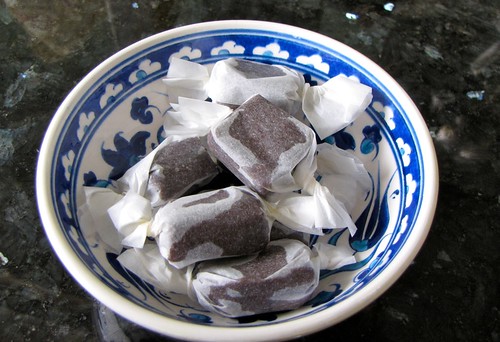
Chocolate caramels

I’ve been enjoying the new food TV series ‘Sweets made simple‘, catching up on the first two episodes on iPlayer.
They successfully rattle through four or five recipes an episode, and succeed in making the finished sweets look both tasty and, yes, simple.
In fact, I think they make both caramel making and chocolate tempering look a bit too simple – it’s quite possible to come across problems with both of these techniques, which they don’t really address.

As usual, my particular bugbear is their lack of explanation of the various rules and instructions (although I concede that exploring these would create a rather different programme). Here are some of the techniques and tips they mention, with a bit of further explanation about them. So here’s a bit of a breakdown of some of things they mention in passing, with a bit more on what’s behind the advice.

Part 1: Caramel making and sugar syrups

Heavy bottomed pan

They are sure to mention that you should use a heavy-bottomed pan when making a caramel. What’s so special about a heavy bottom? What they really mean is a pan that has a sandwich of metal on the base, typically a disc of aluminium, fused to a stainless steel pan. This type of pan will help distribute the heat evenly across the base, as aluminium is a good heat conductor, much better than steel. This will help to avoid hotspots, which can be a particular problem with sugar syrups and caramels, where you are trying to reach a specific temperature across the whole mixture, and where stirring could create crystals that cause the whole lot to become grainy.
In fact, an alternative to the recommended ‘heavy bottomed pan’ is a distinctly lightweight (though not cheap) unlined copper pan, as copper is an excellent heat conductor.

Temp goes fast and then slow

Kitty sensibly mentions that when making a sugar syrup, the temperature will rise fast to 100ºC and then go slowly. The temperature of the syrup is related to how concentrated it is. As it heats up, more and more water boils off, leaving a more and more concentrated sugar syrup behind. While the mixture is mostly water, the temperature will remain at, or very close to 100ºC. It’s only when the syrup is almost all sugar that the temperature can start to rise again. For instance, if you heat to 260F/ 127C you have reached ‘hard-ball’ stage, which is used to make marshmallow, for instance, and the syrup will be 92% sugar and 8% water (see here for more details on the link between temperature and sugar concentration).

This is why the specific temperatures are so critical with sugar work – they determine what the texture of the cooled sugar will be. To make a caramel, all the water has to be boiled away, until you have just molten sugar, which when heated further, will caramelise, firming new molecules and turning first golden, and then dark brown.
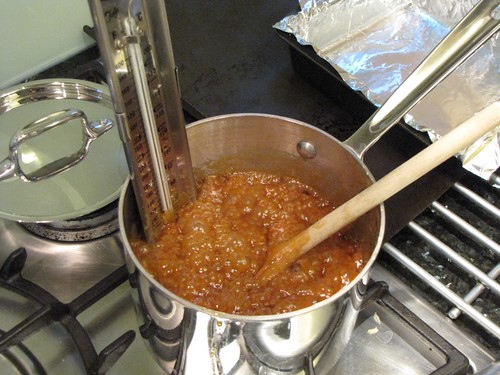
Caramel - 3

It will froth up

I’m thinking particularly of the marshmallow recipe, where soaked gelatin sheets are added to sugar syrup, but this applies to anything where you add something containing water, like cream, butter or soaked gelatin, to a syrup or caramel where most or all of the water has been boiled off. As the watery ingredient hits the hot syrup, the water instantly boils, producing a huge mass of bubbles that make the syrup froth and foam. This is why it’s usually a good idea to use a high-sided saucepan when doing sugar work.

Using liquid glucose

A couple of the recipes have suggested adding a small quantity of liquid glucose or golden syrup to the white sugar used for most of the recipe. The reason for these is the same as why Kitty often tells you not to stir as the mixture is heating. When you heat up sugar and water, and start to concentrate it by boiling off the water, it’s easy to trigger the sugar into crystallising again. This produces a grainy white mess in the pan. Putting in a spoon can give the sugar something to crystallise on, which is why sugar recipes often advise you only to swirl the pan. Adding a liquid sweetener like liquid glucose or golden syrup disrupts the crystallisation process, adding in sugar molecules that don’t fit, and making it difficult for the white sugar crystal to reform.

Back soon with more on chocolate and tempering.

Making chocolate caramels

Chocolate caramels on Flickr

Buying a sugar thermometer seems like the sort of thing only crazy people do. It seems to sit along deep fat fryers and foam-generating siphons as the sort of equipment only professionals and obsessives really need.

The crucial thing about a sugar thermometer is that it allows you to measure a very simple property – the concentration of sugar in a syrup. That’s it.

Water  boils at 100°C (at sea level), and adding sugar to the water raises the boiling point up and up. Caramel is just very hot sugar, that has started to develop complex flavours, a little like browning meat. So a sugar thermometer makes caramel as well as jam a much more predictable affair, and removes much of the guesswork. I have both a glass thermometer, and a new and shiny digital thermopen. If using a glass one, be careful that you have enough liquid to immerse to the line it indicates, or the temperature won’t be accurate. You also need to make sure you put the thermometer in the pan early on – adding a cold thermometer to boiling caramel is a recipe for broken glass in your caramel. A good idea would be to warm the thermometer in the cream, then put into the caramel mixture once the cream is mixed in.

I like making caramel, because the ingredients are so simple and cheap: sugar, butter, cream – but the results are so complex in flavour. Depending on how long you cook this, and to what temperature, you can have a caramel sauce, soft, chewy caramels or hard toffee. I prefer a fairly soft caramel, that is still firm enough to slice and wrap.

These chocolate caramels are a beautiful combination of the buttery flavour of caramel with dark chocolate to balance the sweetness. I was surprised that the recipe asks you to cook the caramel with the chocolate in to a high temperature – I expected the chocolate to burn. I stirred fairly frequently to make sure it didn’t catch on the bottom of the pan, and there was no trace of burnt flavour in the caramel, so I guess it worked.

For more on regular caramels (without the chocolate), Dan Lepard has a great all-purpose caramel recipe he wrote for the Guardian a while back.

Salted chocolate caramels

Adapted from Smitten Kitchen, who in turn, adapted from Gourmet

Usually I would list the ingredients as I go, but it’s especially important to have everything prepared in advance for caramel making, so I have separated the preparation and cooking stages.

Preparation:

Line an 8 inch square pan with foil or two strips of baking parchment at right angles. If using foil, brush with a thin coating of vegetable oil. Set aside.

Chop:

150g dark chocolate

into small pieces and put into a heatproof bowl.

Place

240ml double cream

into a small pan.

200g granulated sugar

Put into a thick-bottomed pan, something quite tall as it will bubble up later (use your best pan for the sugar, and second best for the cream)

Measure out:

60g golden syrup

and

30g butter

and

1/2 tsp coarse sea salt, crushed into fairly small crystals

(this is optional, but very good. Maldon salt or fleur de sel is good. Table salt is not – it will be far too salty).

and put aside, near the stove.

Cooking:

Heat the cream until tiny bubbles start to form at the edge of the pan

Pour immediately over the chocolate, and stir gently until the chocolate is completely melted and the whole thing is smooth.

Add a tablespoon of water to the sugar in the pan, just enough to make it a little damp, and put over medium heat until the sugar dissolves. Keeping a lid on will help it heat faster, and make sure that the sugar gets dissolved properly. Once it is all clear and liquid, remove the lid, turn the heat up to high and boil furiously to make caramel. You want to bring it to a fairly dark amber, without burning it. When it starts to become golden, turn the heat down a little so you can control the process a little better.

Remove from the heat and add the golden syrup, and then, gradually,  the chocolate and cream ganache. Stir after each addition. It will bubble up furiously as the water in the cream is liberated to steam all at once – the caramel will be much hotter than the boiling point of water.

Once everything is combined, return to the heat with a sugar thermometer and bring to the boil again. Heat until the temperature reaches 255F/124C. Any lower, and you risk a pourable, liquid caramel (although if you want caramel sauce, that’s fine). You can take it higher, and get a firmer caramel, until it starts to become toffee.

Immediately remove from the heat, stir in the butter and the salt if using. Stir to incorporate the butter thoroughly, then pour into the prepared tin, and leave to cool and set.

Once completely cold, lift the caramel out of the pan with the paper or foil, and turn upside-down onto a cutting board. Use a large knife to slice into strips and then squares. Wrap each piece in a square of baking parchment or greaseproof paper. Or just eat quickly 🙂

Store in a sealed container – exposure to the air will allow the caramel to absorb water from the air, and it will start to become too sticky.