
In the last post, I talked about shaping buns and rolls. In this one, I thought I would review some of the components of a great fruited bun recipe.
I like buns, I have a stash of home-made hot cross ones in the freezer at the moment, and I think, like Azelia, that you can make them all year around, not just for Easter. All you need to do is leave off the cross, and have them for breakfast, a mid-morning snack, afternoon tea or something to finish the day when you get in late.

Before chemical leaveners, like baking powder and bicarbonate of soda became available, a bit of yeasted bread, perhaps with extra butter and sugar added to it, and some currants thrown in, was what a cake was made of. Eliza Acton’s book ‘Modern Cookery for Private families’ , first published in 1845, featured many more yeast-risen buns and cakes than butter and sugar ones. Before sugar became inexpensive and easy to buy, adding dried fruit to bread was a good way to add sweetness. You can find these ancestors of modern cakes in every part of Britain. The Irish Barm Brack, Welsh Bara Brith and Scotch Black Bun were all based, at least originally, on a yeasted fruit bread. Some of these developed into tea breads and tea bracks, where cold tea was used to soak the fruit, and the whole mixed with flour and an egg to make a soft sliceable loaf.
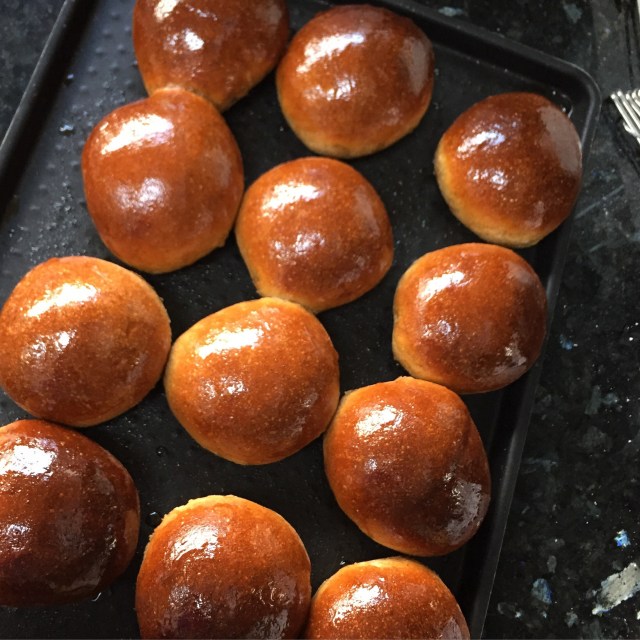
Most fruit or spiced buns will aim for a soft texture, with a thin, soft crust, and a slightly sweet flavour, complemented by the fruit and spices. Getting a good soft texture can be tricky, especially if you’re used to making bread with thick crusts and open, holey textures.
Here are the important elements for a fruit bun dough that I’ve assembled from advice in a whole series of sources (see References), as well as my experiences.

Fat
I used to make bread and discover that although the result seemed pleasing, sometimes the coarse, rustic nature of the bread, with big jagged holes and chewy crumb, wasn’t what I was after. What I needed for those loaves was a little fat. Even just a tablespoon of oil will make a big difference to the softness of the bread. A small amount of fat is needed for fruit buns – butter is good – to keep the crumb soft, and also to make sure it stays soft a little beyond the first day.
You can rub butter or another hard fat into the flour at the start of mixing, or add melted butter or oil with the liquid to the flour. In both cases, the fat will be evenly distributed and will have the effect of coating the flour granules. This gives them a little raincoat, waterproofing them a little so that the water on those granules doesn’t create gluten, or creates less of it. Remember, flour + water + time = gluten.
The effect of this in the finished loaf or roll is to give you a softer crumb, something that feels fluffier. For some reason, it also helps the bread to last after it’s baked, keeping it soft for longer, and delaying staling.
You can also use fat to coat the dough at the shaping stage, giving you separate pieces of pull-apart dough when it is baked. This is what helps to separate the layers in a Chelsea or a cinnamon bun, and what makes monkey bread pull apart. Those streaks of fat prevent the dough from meeting and sticking together, so you still have separate pieces of dough, nestled into each other.
You can see these layers dramatically in the Nordic bakery cinnamon bun.

Roux
You can also get the effect of a soft crumb by doing something different to part of the flour: heating it to explode the starch granules. When you make a roux or a white sauce, you heat the flour with butter, then add milk (or stock) and create a thickened sauce. The thickening comes from the starch granules that burst in the heat and swell with the water added to them. This starchy gel can be used, when cooled, as an ingredient to make fluffy white rolls or burger buns. (Dan Lepard has a great recipe that he developed for the Hawksmoor restaurants).
Sugar
Small amounts of sugar will speed the dough along as well as sweetening it, so be careful that it doesn’t over-rise or over-prove, and then collapse. However, larger amounts act to dehydrate the yeast cells, slowing down their growth. For this reason, be careful when adjusting the amount of sugar in a recipe, and keep a careful eye on the dough as it rises – if it over-rises before you can get to it, you may find the yeast is exhausted before it can get to the final rise.

Fruit
Dried fruit can absorb moisture from the dough as it rises, drying things out. For this reason, you can soak the fruit overnight first, as Dan Lepard does in his stout buns recipe in ‘Short and Sweet ‘. Alternatively, you can increase the liquid in the recipe to compensate. Fruit also adds sweetness, and will not affect the yeast in the same way as sugar added directly to the dough (I think), so it can be a good way to make a sweeter bun without affecting the yeast too much.
Of course, you can always make a fruit bun without fruit – using just spices or perhaps chocolate chips, as they do at Gail’s bakery for their Soho bun.

Spices
Spices including cinnamon and cloves have an anti-microbial effect, so they will slow down the yeast, by killing off or slowing a proportion of the cells. A long, slow rise before you add the spices can help giving the yeast time to get going. Or the spices can be rippled through when shaping, as they are when making Chelsea buns or cinnamon rolls.
Milk
Milk seems to be beneficial for soft buns, but I can’t really pin down the reasons why. Harold McGee does highlight that scalding the milk and then cooling it before using in the dough helps to destroy an enzyme that would otherwise interfere.
Elizabeth David notes Eliza Acton’s insistence that milk makes a big difference when you want bread or rolls with a thin, soft crust. This effect seems to be mainly due to the fat in the milk.
Some good fruit bun recipes:
Dan Lepard’s Cider Hot Cross Buns
Azelia’s Dairy Free conversion and notes on the same recipe
and if you don’t want fruit you can always try:
Nordic Cinnamon buns from Nordic Bakery
Debs’ Hot Choc Buns
References
- Elizabeth David’s English Bread and Yeast Cookery is a comprehensive look at all sorts of breadmaking, covering the role of different ingredients, the history, and lots and lots of recipes.
- Dan Lepard, ‘Short and Sweet‘ is full of all sorts of baking recipes and advice, but has good section on sweet breads, including fruit buns, teacakes and sticky buns.
- Harold McGee, ‘On Food And Cooking
 ‘ is the bible for finding out exactly what’s happening with your ingredients and recipes

 Using Mainly Spoons