Friday food links – 25 March 2016

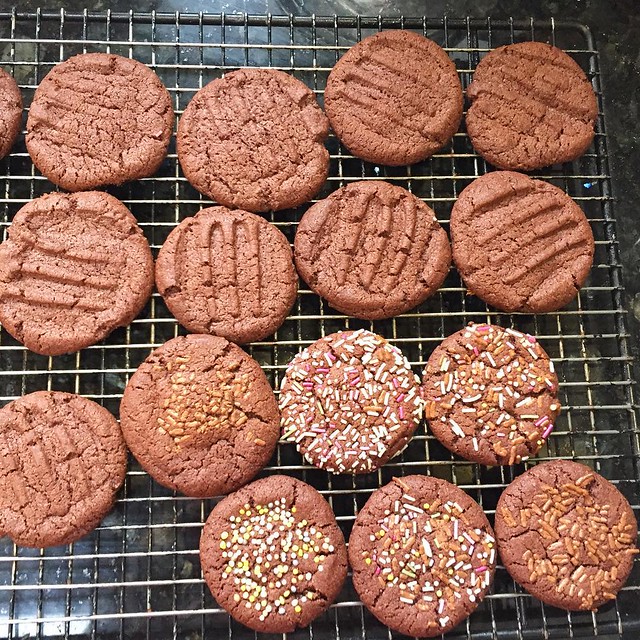
Product of toddler baking session: Idiot biscuits. Actually, she mainly poured sprinkles around, but kept her occupied.  Recipe: http://www.theguardian.com/lifeandstyle/2014/jun/21/pitchfork-fair-mums-chocolate-biscuits?CMP=Share_iOSApp_Other

I knew at the start that this could be a tough week. Lots of travel, a few end-of-year things at work, combined with lots of people on leave meant I already knew time would be at a premium. Add to that a bit of a sniffle for me, full on vomiting from E on Wednesday evening, and a bit of a grey and damp week, and it hasn’t been a brilliant time.

There have definitely be rays of sunshine breaking through, though. Last Sunday the sun came out, and it was actually warm, at least with the sun on you. I got into the garden and planted a few things, and generally felt better about the state of things. The first of my tulips have started showing their heads. And in between being a bit tired and under-the-weather, E has been very funny. In the Disney store, she spotted a clip of ‘Snow White’ playing on the monitors, and started dancing along with the dwarfs. I bought her a pack of farm animal stickers, and she sang ‘Old Macdonald had a Farm’ to them.

Knowing it wasn’t going to be an easy week, I planned some easy meals to get us through. A bought lasagne for midweek. A big batch of curry at the weekend that saw us through three meals. A fridge-tidying soup that covered a couple of lunches and a dinner too.

Recipes:

Without a recipe:

  • Charlie Bigham lasagne with a grated carrot salad and some radishes and cucumbers
  • Egg fried rice
  • Fish and chips from the freezer
  • A green minestrone, using up lots of leftover veg from the fridge, with a parmesan rind, a can of cannellini beans and lots of parmesan grated on the top.
  • Leftover coconut curry – reappeared twice

Reading:

Milk bread

Milk bread

I sometimes feel that we mis-sell homemade bread. All of these ‘best bread of your life’ articles and books sell a particular vision: a craggy, very dark brown loaf, with a thick crust, and chewy, irregular interior. Loaves that take long and patient work and probably require a starter or levain of some sort. And it’s true that these loaves are achievable at home and all that time develops lovely flavours. But not everyone really likes eating them.

When you want to make a sandwich, or some really good, golden toast, that isn’t what you need. Sometimes there is a place for a soft, fluffy bread, with a thin crust that will toast really well, and won’t take three days to make. When that is what you’re after, and if that is your definition of really good bread, then what you need is a milk loaf, or a pain de mie.

This bread comes together in a few hours (although you can leave it overnight if that’s more convenient). It’s a great choice for sandwiches, toast, and even toasted sandwiches. It’s likely to be popular with children. It is gently golden on the outside, with a soft texture inside, but not as spongy and squishy as a cheap sliced loaf. A little sugar helps it to brown nicely when toasted. Not too much liquid means a nice even interior, without jagged holes that let the filling through.

Behind the recipe

All those macho, craggy loaves are flour, water, salt and yeast (or sourdough starter). Milk bread contains a number of other things: milk, butter and sugar. All of them get in the way of the flour a bit, and turn the interior from chewy and stretchy to soft and fluffy. You can also use eggs, or even a roux of cooked flour and water to soften bread. But milk, and a little butter and sugar make a nice soft loaf, but without too much richness.

The fat in the milk, and in the small amount of butter help to interrupt the gluten structure, and stop it from becoming too coarse and chewy. Baking at a high temperature for a short time prevents the crust from drying out too much and getting too thick and crusty. You can also cover the bread with a tea towel when it comes out of the oven to keep the crust soft. Some say that scalding the milk briefly will help to deactivate an enzyme in the milk, and allow the bread to rise a little more and be fluffier. I tried this with and without scalding, and couldn’t tell the difference. I warm the milk up to give the dough a headstart, and to melt and dissolve the butter and sugar, making them easier to distribute, but there’s no need to simmer it.

Milk bread recipe

  • 500g strong white bread flour
  • 1 tsp fine salt
  • 2 tsp instant dried yeast
  • 150ml whole milk
  • 1 scant teaspoon sugar
  • knob of butter – 15g/1tbsp
  • 160ml water

Mix the flour with the salt and yeast.

Add the milk, butter and sugar to a small saucepan and heat the milk just until the butter melts. Take off the heat and pour in the cold water, and wait until it has cooled down so it feels just warm to the touch. (Temperatures over about 50°C will kill the yeast – that feels very hot to touch).

Add the liquid to the flour and mix everything together with a wooden spoon until all the dry flour is gone. If you have time, leave it for 20 minutes for the liquid to be absorbed and to help develop the gluten (this is called an ‘autolyse’).

After that time, knead for about 5 minutes by hand, or with a dough hook on a mixer (or even in a food processor) until you have a smooth and springy dough. Put into a bowl and cover with cling film. Leave to rise for about 1.5 – 2 hours in the kitchen  – no need for a warm place – or overnight in the fridge.

When the dough has roughly doubled in size, and seems very puffy, briefly knead it and pat into an approximate square. Shape into a loaf by rolling it up, and put into a greased 2lb loaf tin. Alternatively you can shape the dough into two or three balls of dough and tuck them into the tin together.

Dust the top with flour, cover again with cling film, and leave to rise for about half an hour. While it is proving, pre-heat the oven to 210°C/190°C fan for about 40 minutes or until golden brown. Leave to cool before slicing – the bread will be gummy if you slice it while it’s hot.

This dough can also be made into rolls, for burger buns or sandwiches.

Bread rolls


Friday food links – 18 March 2016

Following Tamar Adler's advice and doing a batch of veg roasting and sautéing. Very satisfying.

I recently started reading Tamar Adler’s Everlasting Meal. If you’ve seen her extracts in the Guardian Cook supplement, you’ll have an idea of her tone. The language can feel a bit unexpected for food writing, but I think her ambition to imitate the approach of MFK Fisher is at least partly successful (and that’s a high bar). Among the digressions, there is a lot of practical advice.

This week, when the veg box arrived on Tuesday, I followed her advice to do a big batch of preparation all at once. So I roasted a butternut squash and a leftover sweet potato with a little chilli. I sliced and roasted a lurking fennel bulb. And I sliced and roasted cherry tomatoes, leaving them in with the oven turned off to get all ‘sunblush’ texture. Then I shredded the huge heap of cavolo nero and cooked it slowly on the stove with a little onion. This all made it easier to stick extra vegetables on the table this week.

Recipes:

Without a recipe:

  • No-knead bread
  • Fish pie – with prepared ahead roast squash and garlicky sautéed leftover broccoli

Reading:

Friday food links -11 March 2016

Kew in Spring - crocuses

The week started slowly, as it is likely to do when you accidentally poison yourself by eating soft cheese that has been lurking in the fridge too long (oops). Then a busy week, with guests, which means not much in the way of innovation for dinner. Time to go to the old stand-bys, the things that can come out of the freezer: leftover roast chicken made into soup and risotto. Minced beef into ragu into lasagne. Chicken and lentils cooked all day for a mild, toddler-friendly curry (even if she only ate the rice anyway). Although mornings are still frosty, the sun is warm when it appears, and the tulips are well on their way now. I have the first broad beans (though Italian) in my organic box this week, so maybe spring is on the way.

Recipes:

  • Apple crumble – James Morton’s ‘How Baking Works’
  • Slow cooker ragu – ‘Slow Cooked’ – Miss South
  • Sake steak – Nigella’s ‘Feast’

Without a recipe:

  • Roast chicken, chipolatas, roast potatoes, roast butternut squash, broccoli
  • Lasagne  (using the slow cooker ragu)
  • Squash soup (with leftover roast squash)
  • Chicken risotto
  • Slow cooker chicken curry
  • Milk bread (again – trying to get the recipe right)

Reading:

Friday food links -3 March 2016

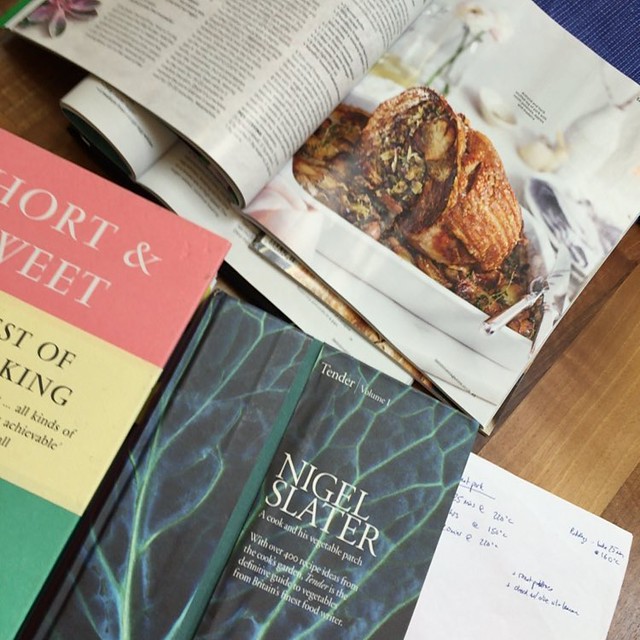
Figuring out dinner menu for tonight: slow-roast pork shoulder from @deliciousmag , roast potatoes, chard and marmalade sponge puddings for dessert 😋

I’m just starting to emerge from a week of being submerged under a cold. The headache is lingering, but I think I’ve turned the corner, and the sunshine today is helping too. Given the shortage of energy around here, this week’s food was anchored by leftover roast pork from Saturday, and a pot of soothing dal cooked midweek.

Dal is a great food to have when you’re feeling under the weather. It’s not very demanding to cook – at least the way I do it. You end up with something as soft and undemanding as mashed potato, but with a bit more flavour (I like to simmer it with turmeric and ginger) and a feeling that it’s doing you some good.

Recipes:

Without a recipe:

  • Dal, with sweet potato and chickpea curry from the freezer
  • A made-up pasta sauce with leftover roast pork and tomatoes
  • Ham hash – leftover roast veg, ham hock, with a fried egg on top, with cime di rapa on the side.
  • Weekend pizza
  • Pork stir-fry with broccoli and courgette
  • Milk bread (recipe coming soon)
  • Something between a quesadilla and a taco, with ham hock, caramelised onion, manchego and cime di rapa.
  • Foccacia with onions – from leftover pizza dough
  • Breaded fish with oven chips

Reading: