Cake baking – more cake foundations

In the last post, I looked in detail at creaming the butter and sugar, the starting point for many cakes. This post follows what happens next – adding the eggs, flour and then baking.

Fairy cake inside

I found a great description of what happens in a cake in Rose Levy Berenbaum’s Cake Bible:

“Ingredients fall into two categories: those that form and strengthen the cake structure and those that weaken it”.

The flour and eggs provide the protein that holds the cake structure up, and stop it from collapsing into a pancake. The fat, sugar and leavening all weaken the structure in different ways, making the cake tender and soft instead of tough and chewy. The balance between the two sides is important for capturing the air that makes cakes soft and light.

Adding eggs – what happens when it curdles

Almost as soon as I put the last post up, someone asked what happens if the mixture curdles. I have looked into this problem before – most people seem to say it can be avoided, perhaps marginally reduces the volume of the final cake, but if it does happen, you can carry on without problems.

But what was unclear was what caused it to curdle in the first place – was it really not enough creaming, or something else?

Curdled mixture with eggs

When the mixture curdles, what you see appearing are lumps of fat and sugar, surrounded by a thin watery liquid. The clearest explanation I found came from Shirley Corriher in ‘Bakewise’. She describes this as a:

“switch from the the water-in-oil emulsion that you want to an oil-in-water emulsion”.

This probably only makes sense if you know what an emulsion is. An emulsion is simply one liquid suspended in another. In this case, when you start to add the eggs, you are aiming for little droplets of the water from the eggs, suspended through the fat-and-sugar mixture that is already there. At some point, the liquid from the eggs can overwhelm the amount of fat, causing the bubbles of water to all join up and become the main part of the mixture – the continuous phase, as it’s called.

To prevent this happening, you need to ensure that the fat and sugar are able to hold as much liquid as possible – which means soft, but not melted. You also need to add the egg very gradually, so that it doesn’t overwhelm the mixture. This is the same principle as adding oil to mayonnaise – go slowly and incorporate each bit before you add some more.

Finally, the solution once it has curdled – which it might well do – is to stop beating it and add some flour. This will absorb the excess liquid that’s starting to pool, and shift the balance back again.

With flour added

Speaking of Shirley Corriher, this is a brilliant excuse to link to my favourite food science programme, Good Eats:
Good Eats: A Cake on Every Plate

Shirley appears at about 4m30 (disturbingly extolling the virtues of cake flour, which you can’t get in the UK because it’s chlorinated, and the EU aren’t big fans of that idea).
Alton also talks about creaming and bubbles at about 8m30. He also has kick-ass flames painted onto his KitchenAid mixer.

Adding flour

Once the eggs are in, the final step is to add the flour, and any liquid that might be called for. These are often added in alternate batches, so that the mixture gets neither too stiff nor too runny as they go in – either might deflate the air.

An often neglected step is to thoroughly sift the flour and baking powder together. This isn’t necessary if using self-raising flour, but when adding baking powder, there is always the risk that small lumps of leavener will persist in the batter, and produce large ugly holes in the final cake. If you really want a fine texture, sift two or three times before it goes into the batter.

The other important thing when you add the flour is to stop folding or stirring as soon as the flour has disappeared into the mixture – don’t mix any more than you need to. As soon as the flour makes contact with the liquid in the eggs, and any added liquid like milk, it will start to make gluten. The more you mix at this point, the longer and stronger the gluten will become, and the tougher your cake will be.

Baking

The final point is on baking. The balance here is between allowing the leavener time to work and expand, and setting the egg and flour proteins in a structure that will hold the air. Bake at too high a heat, and the leavener might not have had time to work before the batter sets, making a more dense cake with a closer texture. Bake at too low a temperature, and the gas might bubble to the surface and disperse, and so be lost that way. A medium temperature will set the batter at the right point, and bake through evenly without making the surface too dark and brown.

An alternative method – the two stage approach

When consulting Rose Levy Berenbaum, I discovered that she actually doesn’t recommend creaming at all. Her favoured approach is a different one completely. She combines the flour, sugar and fat together with a little egg, and beats thoroughly to incorporate air. Then she adds the remainder of the egg, and other liquid in batches.

This approach takes a different route to the issues above. By combining the fat directly with the flour, it can be coated to prevent the liquid getting at the protein and forming gluten. The flour-sugar-fat mixture can still hold air, so the creaming still generates volume. And the eggs are added only once the flour is already there to absorb liquid, so there is no risk of curdling.

I haven’t tried this approach more than once or twice, but I will be trying it out alongside regular creaming to see what effect it has. Watch this space.

Creaming – the foundation of cake making

Baked until golden

Cakes are demanding, and learning to make a good cake needs more than a recipe. So many little details are important. One of the essential details, at least for most British cakes, is beating the butter and sugar until truly pale and fluffy – creaming them together. If you’re making a Victoria sponge, a layer cake or a cupcake, you almost always start by creaming together the butter and sugar.

What is creaming?

For a long time I didn’t understand creaming at all. The recipe phrase is usually ‘cream the butter and sugar together, or ‘beat until light and fluffy’ or ‘beat until it turns a shade paler’. The big problem with these directions is that they don’t convey the change you need to see. You start off with a greasy paste of butter and sugar, but end up with something more like slightly yellowed whipped cream instead of butter.

Creamed butter and sugar

I only really got creaming when watching a demonstration by Alice Medrich, an American baker and chocolatier. She was making her Tribute cake, a layer cake of featherlight chocolate sponge with whipped chocolate ganache filling and a smooth, shiny chocolate glaze. She left the mixer running for a good five minutes when creaming the butter and sugar – much longer than I had expected.

Think about it this way instead: most of the frosting that is now applied in towering heaps to American cupcakes is made of this same mixture. They tend to use icing sugar instead, so the texture is even smoother, but the volume and the fluffy texture are the things you’re aiming for.

Why is creaming important in making cakes?

Cake texture

The structure of a cupcake is a foam, a web of flour starch and egg proteins, with many tiny bubbles. The batter you end up with is quite delicate, with just enough connection between the ingredients to hold the all-important air in there. This is the biggest difference between a sponge and other types of cake.

Marrying butter and sugar is a task at once completely simple and immensely complicated. It is the foundation of cake bakery, the structure upon which everything else stands. Build it carelessly, and the rest of the structure may wobble and fall. Of course, you can insure yourself against these errors with other supporting structures, but when you want to move on to the virtuoso pieces that really depend on the foundation, that strip everything else back, you will find it hard.

What is happening when you cream together butter and sugar is that the sugar crystals are helping to create bubbles in the fat as they are beaten. Air is what creaming is all about. Beating faster and longer creates more and more bubbles, and creates a finer texture. Any time you introduce bubbles of one thing into something else, it will become more opaque and paler. This is true of vinaigrette, of hollandaise, of whisked egg whites and of creamed butter and sugar. All the little bubbles start to interfere with the light, bouncing it around more and making it look paler.

How do you cream butter and sugar for sponge cakes?

Hannah Glasse in 1774 described the final state as a ‘fine thick cream’. She suggested that using your hand, this should take an hour. Another 19th Century book suggests it is “the hardest part of cake making” and you should have your manservant do it.

In the absence of a man-servant, a handheld electric mixer or a stand mixer like a Kitchenaid makes this much, much easier. With a small quantity it can be done by hand, but expect a decent workout. You need the mixture to change colour – as the air is incorporated, the bubbles make the mixture look paler. The texture also becomes much fluffier.

Creamed butter & sugar

When you’re creaming butter and sugar together, it’s more or less impossible to mix for too long. You at least need the mixture to become one shade lighter. By mixing it for long enough, it should be possible to make it turn almost white, as the sugar crystals introduce more and more air into the fat. All of this isn’t really conveyed by the simple words ‘cream the butter and sugar’.

In a follow up post, I’ll talk about the subsequent steps in making a sponge cake, which follow on from the creaming step.

Pistachio gelato

Pistachio gelato

I tend not to buy completely unknown ingredients – my cupboards are too full for that. But if something rings little bells of recipes I have seen before, then I’ll pick it up, and work out what to do with it later.

I like discovering new ingredients in this way. They present a new frontier of challenges, a new coastline to be explored. They give me a starting point to wander through my cookbooks and discover new things. (And have I mentioned how brilliant Eat Your Books is for this? This indexing service does what I have never had time to do: provides a list of all the recipes in cookbooks and magazines, along with a listing of the ingredients in them, so you can search through all your book indexes at once).

So when I was browsing for Christmas presents in Gelupo, a gelateria in Soho that is the sister location to Italian restaurant Bocca di Lupo, and spotted pistachio paste, I bought it without knowing how I would use it.

Pistachio paste

I’ve come across recipes asking for pistachio paste in the past. It’s like a pistachio version of smooth peanut butter, and has that nutty flavour and sticks to your palate in the same way. It is often used in professional recipes because it is so smooth, and because it provides a concentrated pistachio flavour.

Although the Gelupo staff seemed convinced that the pistachio paste wouldnt go off, I know that nut oils can go rancid quite fast, so I opted to store it in the fridge. And there it sat over Christmas while I wondered what to do with it. I thought about pistachio cakes and biscuits, where that bright green colour could really be shown off.

In the meantime, I got the Bocca cookbook for Christmas. And, of course, the answer I was looking for was pistachio gelato.

Pistachio has been my favourite ice cream flavour for ages. When on holiday in France as a child, I would usually order a double cone with one scoop of chocolate and one of pistachio (either that or coffee and chocolate). I even tried to make pistachio ice cream at home when I was 12 or 13. The results, using nuts whirled in a not particularly powerful food processor, were predictably grainy. There was still a whisper of the right flavour there though.

Gelato is something that you mainly see in Italy and the US. Whereas ice cream is properly made with cream and thickened into a custard with egg yolks, gelato is made with milk, and instead of being thickened with eggs, it uses either gelatin, or cornflour or both to thicken the mixture. Gelato fans say that the lower fat content and no eggs allows the flavour of the gelato to be less obscured than that of ice cream. Explaining its appeal in the Bocca cookbook, Jacob Kenedy says: “a flawless representation, like that of Dorian Grey, the picture is so perfect it steals its subject’s soul”.

What’s missing from the recipe

Following the theme of my last post, I wanted to look in more detail at this recipe, and why it works the way it does. The recipe asks you to make a ‘base bianca’ first, with milk, cream, sugar, honey or glucose, and milk powder. This is then heated and gelatin stirred in to dissolve before chilling it. Finally, more sugar and the nut paste are whisked in before churning it in an ice-cream maker.

It took me a while to understand the reason for some of the instructions in the recipe. It instructs you to remove it from the heat “when the mixture approaches a simmer”. Apart from being a very unhelpful instruction (how do you know it’s approaching a simmer until after it’s simmering?), was there a reason for needing to heat to a specific (unnamed) temperature, rather than just enough to dissolve the sugar and milk powder?

I remembered that I had read about the need to scald milk for bread making, to destroy proteins, and wondered if the purpose was similar. In Shirley Corriher’s food science book ‘Cookwise’, she explains in the Ice Cream section that:

“one step is essential for optimum smoothness if using any milk or half-and-half in the recipe. The milk or half-and-half should be heated to 175F (79C), just below scalding. I do not know the exact nature of the changes that this heating causes – perhaps denaturing or partial coagulation of some of the proteins. Whatever it is, the effect is a noticeably smoother texture in the ice-cream.”

Further clues are given by Harold McGee when explaining commercial ice-cream making:

“If carried out at a high enough temperature (above 170F/76C), cooking can improve the body and smoothness of the ice cream by denaturing the whey proteins, which helps minimize the size of the ice crystals.”

This recipe in fact contains three magic elements to make it smooth and creamy:

  1. the heated milk denatures the whey proteins, adding proteins to interfere with ice crystals
  2. the gelatin acts as a stabiliser, adding yet more protein, both thickening the final result, and interfering with ice crystals forming
  3. the honey or liquid glucose, which lowers the freezing point, and produces a softer texture at a given temperature. All sugars lower the freezing point of water below 0C. This site explains that the smaller the sugar molecule, the better it is at lowering the freezing point. Little glucose is much better than sucrose (table sugar) because it is half the size, sucrose being made of one glucose and one fructose molecule stuck together. Azelia has written much more about using liquid glucose in ice-cream.

The whole mixture is much more liquid than a normal ice cream base when chilled, with barely a hint of thickening from the gelatin.  But the final result is silky smooth, and much more scoopable than a traditional custard ice-cream.

Recipe: Pistachio Gelato

(adapted from Bocca by Jacob Kenedy)

I have tweaked this a little to suit the ingredients I had on hand, using semi-skimmed milk and double cream in place of whole milk with whipping cream. Gelatin can usually be found in the baking aisles – I used a Supercook brand, which comes in packets of 12 small sheets. I have also seen agar agar in some supermarkets – this is the one to choose if you are vegetarian.

Base:

  • 480ml semi-skimmed milk
  • 160g double cream
  • 40g glucose syrup or light honey (I used orange blossom)
  • 130g caster sugar
  • 40g skimmed milk powder
  • 3g leaf gelatine (2 small sheets) or 4 teaspoons agar-agar

Gelato:

  • 85g pistachio paste
  • 45g icing sugar

To make the base: heat the milk, cream and honey in a heavy pan until steaming. Meanwhile, mix the caster sugar with the milk powder in a small bowl. Pour into the warm milk in a stream, while whisking to prevent lumps forming. Bloom the gelatin sheets in a bowl of cold water, and continue to heat the milk. When the mixture is almost simmering, with bubbles around the edge of the pan, remove from the heat and stir in the gelatin. If using agar-agar, sprinkle it over the surface and leave for 5 minutes to swell and ‘bloom’ before stirring in.

Remove the base to a bowl to cool, then chill. When you’re ready to make the ice cream, whisk in the pistachio paste and icing sugar (I did this by hand, but a blender or hand-blender would probably do a more thorough job). Churn in an ice-cream machine, then turn into a container and freeze.

Gelupo

7 Archer Street, Soho, London, W1D 7AU

If you’re ever in London, near Piccadilly Circus, I highly recommend a visit to Gelupo. They serve Italian gelato, as well as sorbets and granitas. They always have new seasonal flavours in, as well as classic Italian flavours that you don’t often see here, like Stracciatella and coffee granita. The fruit flavours are vibrant and clear. You can also pick up little treats like handmade almond biscuits.

What’s missing from a recipe

Last week I made pistachio gelato (post coming soon), a type of recipe I had not tried before. It frustrated me because it included guidance to remove from the heat “when the mixture approaches a simmer”, but no explanation of why this specific heat was needed, nor what would happen if you let it actually simmer. I like to know why I am doing what I’m doing, and in this case, the information was missing.

This is a subject that has been occupying me for some time. The current standard format for recipes was developed during the 19th Century by domestic cookery writers like Eliza Acton and Isabella Beeton. They were the first to write a separate list of ingredients, followed by the method. Before that, the instructions would be very brief, intended as a reminder for those who had already learnt about cooking from their mother or as an apprentice to a cook.

So Hannah Glasse, writing The Art of Cookery, Made Plain and Easy in 1774, could write this recipe for tart pastry:

One pound of flour, three quarters of a pound of butter; mix up together and beat well with a rolling pin.

Recipes like this were never intended to be a replacement for the teaching of cookery. They are still a very limited format. However, they are a popular one, and virtually standardised over the past 100 years, so that most people recognise a recipe layout if they see one, and know what to expect. They also work fairly well as a compromise – something that can be reproduced easily in many different media, and something that strikes a balance between too much and too little information.

However, as a teaching tool for learning to cook they definitely err on the side of too little information. Worse, because they form the main body of most cookbooks, it would be natural for those learning to cook from a book that everything you need to know would be contained in them. This is very far from the case.

It is hard to find information on which parts of the recipe are important, and which are more flexible. Where is it safe to deviate and where is it not? To compound the problem, few experienced cooks know which parts of a recipe are most important to follow. If you always follow recipes, how would you know what happens if you don’t? Or how to fix it if the recipe turns out to be wrong?

What is missing from most recipes is the context-sensitive techniques that allow you to exert your own judgement about the recipe. The understanding you need to decide if something is done, if it has gone wrong or if you should add more or less of something. By implying that the recipe contains everything, we remove people’s capability to make the adaptations that are always necessary, because the circumstances in which we cook are always unique.

In the next few posts, I am going to try and pick out the parts of a recipe that are missing, the bits to pay attention to, and those you can be more relaxed about. Hopefully, this sort of information can then be applied to any similar recipe you come across, rather than being specific to the one you’re looking at. And that sort of knowledge should be more enduring.

Fresh Spring Rolls

from Rick Stein’s Far Eastern Odyssey

Fresh spring rolls

I first came across fresh spring rolls, also known as summer rolls, at a Vietnamese restaurant in Palo Alto. I’d eaten fried Chinese spring rolls many times, so ordered them thinking I would be familiar with them. But what arrived was a very different thing. These were light and springy, full of fresh mint and basil, and came with a thin, sharp dipping sauce instead of a gloopy sweet one. I was very excited when we covered Vietnamese cuisine briefly at cooking school, and I got to make some of these spring rolls. It was then that I discovered how hard they can be to get right. Like rolling burritos, there is a lot of practice needed to get the rolls tight enough to hold together.

Since then, I haven’t often had the chance to taste them. But when I started marking up Rick Stein’s book Far Eastern Odyssey to decide which recipes I would make, this was a must-have. Spring rolls aren’t an everyday dish, but you can prepare most of the ingredients in advance, and then assemble them with a little help in a few minutes. And as they are served cold, this is a really useful, fresh starter or canape to have on hand.

Making spring rolls, like making your own pizzas, is a production line job. You need to prepare all the ingredients ahead, and lots of chopping and slicing needs to be done. This means it makes more sense to make them for a crowd than just for yourself. It probably took me about an hour to put together 8 spring rolls for myself, but I could have made three times as many with just a little more time. Once you have all the pieces prepared, actually making and filling the rolls is fairly quick. This also means that having helpers to do some of the preparation would make things much easier too. You can see (just) in the photo below, my setup for making the rolls:

Set up for making spring rolls

The critical ingredients for fresh spring rolls are:
– rice paper wrappers
– fine rice noodles or mung bean (glass) noodles, briefly boiled or soaked in hot water (according to the packet instructions), then drained and rinsed with cold water.
– herbs – traditionally mint, thai basil and garlic chives. I used mint leaves, Italian basil and spring onions. The spring onions were sliced thin to go into the roll, but the herbs were left whole or in large pieces, to make the rolls more attractive. As rice paper wrappers are so thin, you can see through them, so the layout of the contents affects the appearance.
– vegetables – I used carrot, cucumber and lettuce, but beansprouts are often added. All these were chopped into long, thin strips. The lettuce was torn into small pieces.

Lettuce and pork for spring rolls

– cooked protein – in this case, cooked prawns, and cooked pork. I simmered some slices of belly pork in salted water, then left them to cool, removed the skin and surface fat, and sliced them thinly. The prawns were steamed and then cooled, and sliced in half.

Mint, basil, spring onions

The rice paper wrappers are very thin, and usually have marks on them a little like galvanised drain covers, from the bamboo mats that they dry on. They need to be soaked for about a minute in cold water until they become just pliable.

Then you can pile on just a little of all of the ingredients, starting with the prawns and herbs face down, to give an attractive appearance. Add the other ingredients on top, and roll it up, tucking in the sides to hold everything together. As the rice paper wrapper is slightly springy, you can stretch it a little around the filling, and that will help to hold the roll tight. It will take a bit of practice to get the right tension, so that you stretch but don’t break the wrapper. Some of these are neater than others, but you can see where the prawns show through.

Fresh spring roll

Vietnamese spring rolls are served with a dipping sauce common in Vietnamese cooking, nuoc cham. This is made of fish sauce, lime juice, palm sugar and chopped chilli, ginger and garlic: all the essential Vietnamese flavours in one sauce. Vietnamese food is all about balancing the key flavours of salty, sour, hot and sweet. The fish sauce is salty, the lime juice sour, the sugar balances with sweetness, and the chilli and ginger provide heat (although very little in this dish). Make sure you dip in a little lettuce and taste the dipping sauce – you want it to taste balanced to you, so adjust the quantities if you think it is too salty, sour or sweet.

Fresh spring rolls

Cookbook exploring in 2012

IMG_3777

I have acquired a lot of new cookbooks this year. A lot. In fact, I’ve just counted 24 new books in 2011, including both cookbooks and food writing. Gulp. One of the problems with twitter is that I feel connected to the food writers I follow, and so I feel more or less compelled to buy their books when they come out. It’s like buying the book your friend wrote – it just feels like something you should do to support them. Of course, I don’t know these people personally, but I feel some of that obligation nonetheless. This is not helping my shelf capacity.

Like most people, I haven’t made most of the recipes in most of the books I own – and my habit of constantly acquiring new ones isn’t helping. So I’ve decided to pick a book a month to cook from this year (except December). I’m hoping this will ensure I spend some time really exploring each of these books. It can also be helpful to restrict your choices sometimes. When I’m short of time, I’m much more likely to choose something new to cook if I have a book choice of one, rather than having to navigate the whole bookcase.

This list isn’t just the new books in my collection. It’s more the substantial books that I don’t feel I’ve got into properly yet, and that I think will repay some sustained attention. I haven’t included baking books on this list – I bake so much that it’s not hard for me to work through those. I’ve already made quite a few recipes from Dan Lepard’s magnificent ‘Short and Sweet‘, and I’m sure I will make many more. I won’t be cooking exclusively from these books, or aiming to cook everything in them. This is more of a starting point for when I’m looking for ideas or a cooking project to tackle.

January: Far Eastern Odyssey by Rick Stein

I thought it would be useful to do these fresh Asian flavours in January, when I could do with some spices to brighten things up. A lot of these dishes are store cupboard based as well, and any seasonal ingredients are fairly out of season for us for much of the year, so having to use January produce shouldn’t be as much of a hindrance.

February: Modern Cookery for Private Families by Eliza Acton

This is a reprinted version of a cookbook first published in 1845. This was the source for many of Mrs Beeton’s recipes. I’m hoping that the traditional English food will be just what is needed in February.

March: Secrets of Scandinavian Cooking: Scandilicious – Signe Johansen

I’ve really been looking forward to getting my hands on this one. I follow Signe’s twitter feed and blog, and there have been many tantalising glimpses of her recipes in the newspapers this year.

April: Nutmeg and Custard – Marcus Wareing

I’ve had this book for a quite a while, and made a few things from it, but there are so many tempting recipes here that I wanted to spend some serious time sorting through it.

[Having just received Heston Blumenthal at Home as a late Christmas present this week, I might have to switch this one]

May: Bocca: Cookbook – Jacob Kennedy

I’m a fan of the Bocca di Lupo restaurant, and even more so of their sister gelateria, Gelupo (it’s easier to get in for one thing). I haven’t looked at this at all yet, but wanted to give this a slot that would mean some good fresh produce was starting to appear.

June: Tender: Volume I, A cook and his vegetable patch – Nigel Slater

I’ve also had this for some time, but it’s such a huge volume, I feel I’ve barely scratched the surface. Again, having some good veg to play with feels important here.

July: Supper Club: Recipes and notes from the underground restaurant – Kerstin Rodgers

Kerstin’s book is definitely organised with entertaining in mind, so I’m putting this one in July with my birthday with the aim of throwing some parties that will allow me to use the menus as they are meant to be done.

August: Moro East – Sam and Sam Clark

This book was written around their allotment and the produce it generated, so August felt like a good month to tackle these fresh recipes.

September: The Zuni Cafe Cookbook – Judy Rodgers

I’ve owned this cookbook the longest of this set, but so many of Judy’s recipes feel like real projects, I have avoided many of them. This feels like a good time to really get into some of these multi-day recipes.

October: Made in Italy: Food and Stories – Giorgio Locatelli

I would like to get around to making some of the fresh pasta dishes and the more elaborate restaurant dishes from this. And maybe this is the year I finally break my rule about deep frying at home and make the banana chocolate beignets from this book.

November: The Family Meal – Ferran Adria

I bought this (and had it signed) when Ferran was in London this year, but again, haven’t made many of the recipes yet.

I’m stocking the kitchen now to tackle the pan-Asian flavours of Rick Stein’s Far Eastern Odyssey, so a few recipes from that will be coming soon.

Chocolate raspberry trifle – and a dessert wardrobe

Inside the trifle

Sometimes a dessert comes together that you know is a keeper. If you’re lucky, you know it will be good beforehand, and get all the benefit of the anticipation as well. And sometimes, just the name is enough.

I needed a dessert for lunch on New Year’s Day. It had to suit both adults and kids, and be prepared ahead, to make it easy on the day. Browsing through Nigella for ideas, I hit on trifle. Trifle is a very Christmassy dish – all that custard and cream fits with the excesses of  late December. And because it’s best served in a single bowl, it really needs a decent sized group before it’s worth making. It is indeed something to feast upon.

The original plan was to make Nigella’s Chocolate cherry trifle, but this version really started with the arrival of a bottle of Chambord (black raspberry liqueur) as a Christmas present. I had never tasted it before (and, like all fruit liqueurs, it does have a hint of Benilyn cough syrup about it), but it sparked the idea of a chocolate raspberry trifle, instead of a chocolate cherry one. And I love the combination of chocolate and raspberries – the sharpness of the raspberries is a great match for chocolate.

I had frozen raspberries, and also some shreds of flourless chocolate cake bagged up in the freezer. It did not carry good karma with it – it crumbled as I tried to unroll it as a roulade on one of those days when a bad work day, and a dropped carton of double cream make that the final straw. But I knew it tasted good.

All that was needed to make was the chocolate custard. Although Nigella suggested you make sandwiches of chocolate cake and jam, that wasn’t going to be an option with the delicate flourless cake I had (not least because it was in so many fragments). So instead I thinned the jam with a splash of water into a syrup that could be used to douse the cake.

This was an example of the ‘capsule wardrobe’ approach to dessert making: if you have great components, then you can assemble them in many combinations, and be confident about the result. This is the exception to the rule that you shouldn’t make something for the first time for guests. If you’ve made all the component recipes before, then you can be much more confident that the final result will work.

I’ve stolen this idea from Alice Medrich, who has a section in her book ‘Bittersweet‘ called ‘Basic Wardrobe for Designing Desserts’. This includes recipes for basic cake layers, mouses, fillings, frostings, glazes and decorations that can be put together in different combinations.

In making this trifle, I did what I so seldom do, and tasted everything, every component. When I am following someone else’s recipe, I sometimes assume that if I follow everything to the letter, I don’t need to taste as I go. And if it doesn’t work out, I can just shrug and blame the recipe writer. But recipes don’t work like that, and we can’t help ourselves get it right unless we taste things.

Some of this dish’s success was serendipity, but there was also a set of learned and ingrained thoughts at work. I knew that the flourless cake was light and moussy, so would match the density of the custard and whipped cream well. Having tasted the custard and syrup, they were both sweet, so I knew I needed the raspberries to be quite densely packed to provide contrast.

I’m really pleased with the result, and I’ll even go to the trouble of crumbling that cake deliberately now I know how good it can be in a new incarnation.

A teacup trifle

Recipe: Chocolate raspberry trifle

Serves 6-8

For the cake (this is Smitten Kitchen’s Heavenly Chocolate Cake Roll):

  • 170g dark chocolate, chopped
  • 3 tablespoons strong coffee
  • 6 large eggs, at room temperature
  • 150g caster sugar
  • 1/4 teaspoon salt
  • 2 tablespoons cocoa

For the chocolate custard (adapted from Nigella Lawson’s Chocolate Cherry Trifle recipe in ‘Feast‘):

  • 50g dark chocolate (64% Chocolate by Trish buttons)
  • 175ml semi-skimmed milk
  • 175ml double cream
  • 4 egg yolks
  • 65g caster sugar
  • 20g cocoa
To finish:
  • 300 ml double cream
  • 350g frozen or fresh raspberries
  • approximately 100g seedless raspberry jam
  • 3 tablespoons Chambord raspberry liqueur (optional)
  • Silver balls, stars, chocolate curls or other decorations

Make the Heavenly Chocolate Cake Roll as directed on Smitten Kitchen. You can use another sort of chocolate cake, although this one proved perfect for trifle – partly because I was unable to make it roll up (I left it to cool for too long), and so it crumbled to shreds and ended up in the freezer. But the soft, light texture made a good base for the trifle, without being heavy.

For the custard:

Melt the chocolate gently over a pan of hot water or in the microwave. Set aside. Whisk the yolks, sugar and cocoa together in a large bowl with a pinch of salt.

Heat the milk and cream together until little bubbles appear at the edge of the saucepan. Pour the hot milk and cream over the egg yolk mixture while whisking. Once everything is mixed together, scrape it all back into the saucepan. Heat gently to thicken the custard, stirring constantly and scraping the bottom with a wooden spoon. You need to take it until a thick, shiny layer appears on the back of the spoon. Once it has thickened, scrape into a bowl, cover with clingfilm in touch with the surface and chill for several hours.

Make the syrup: Warm the raspberry jam with a splash of water and about 8 frozen raspberries until the jam melts and the raspberries collapse. Remove from the heat and stir in about 3 tablespoons of Chambord (black raspberry liqueur).

Finally, assemble the trifle:

Line a dish with the chocolate roll cake, pushing the pieces together to make a single layer. Soak with the raspberry syrup. Cover the surface with the remaining raspberries, partially pressing them into the cake. Cover with the chilled chocolate custard and smooth into a single layer. Cover with clingfilm and chill for several hours or overnight.

An hour or two before serving, whip the rest of the double cream (about 300ml) to very soft peaks, and spread over the custard (whipped cream thickens more and more every time you spread it, so whip it very softly, and spread it out with as few movements as possible). Decorate with silver balls, gold stars or chocolate shavings. I used edible gold stars from here.

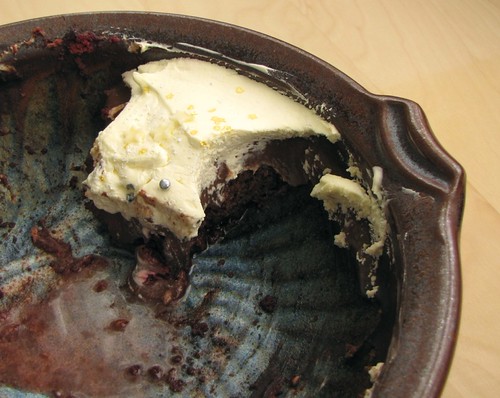
End of the trifle

Gingerbread men (or stars, or trees…)

IMG_1162

Every year I try and make a few homemade things for Christmas to send to friends and take to family. All right, not a few, a lot. There was the year I decided to make two sorts of truffles, dipped in tempered chocolate, and also candy about 5 oranges, slice the peel really thin and dip each piece individually in tempered chocolate. Very messy. I have done brownies, David Lebovitz’s Chocolate cherry fruitcake, and last year, Raspberry truffles. This year, I went for mainly biscuits (with a few caramel brownies thrown in for good measure), and the king of Christmas biscuits is the gingerbread man.

Gingerbread is something that seems quintessentially festive. It has the deep spices that I love about Christmas cooking and decorated with white icing, it reflects ideas of snow and decoration, without being showy. You can make gingerbread biscuits with holes in to hang on the tree – and they will keep remarkably well that way – but I prefer to heap them into a tin, and snack on them. They will always outlast my appetite for them.

This year I made some biscuits to send to friends, and some to keep. I took the leftover scraps of dough with me to my mum’s, as I hadn’t had time to roll them out and bake them. They came up a little chewier and puffier than the rest of the batch, but delicious all the same: my 99 year old grandmother had two (and she doesn’t normally have sweets). Something about the almost austere plainness of these biscuits appeals across the ages. My two year old nephew pronounced them very good, and my 5 year old niece had three in a row just yesterday.

The recipe for these comes from an old issue of the veteran US cooking magazine, Gourmet, now sadly deceased. A few years ago, they did a round-up of cookie recipes from their history, choosing one recipe to represent each year the magazine was in print. This gingerbread recipe was reproduced from a 1959 issue of Gourmet. Although the recipe has now disappeared from the website, you can see the gingerbread men in this video about the project, at 1:42. All the cookie recipes they selected are now in the Gourmet Cookie Book.
IMG_1157

The first time I made these, I used currant eyes, and sliced almond mouths to make the faces. These were beautiful, but so time consuming to place every piece. I have decided I much prefer to ice with a little royal icing after they are baked instead. I can add faces and buttons to the gingerbread men, as well as dots and snowflakes to star-shaped cookies, and snow-laden branches to the christmas trees. Or they are very good just plain, as they are or dipped into a cup of tea to soften the edges a little. Like the best gingernuts you’ve ever come across.

The other benefit of not fiddling with currants before baking is that you can put the dough into the oven still cold, which makes the shapes better defined when baked, and less puffy. When first made, the dough will be quite soft. I have added even more flour than the original recipe states, to make it a little easier to handle, and to make sure that the cut-out shapes stay well defined. However, if the dough gets warm as you roll it out, the shapes will become floppy and will be hard to transfer to a baking sheet without distorting them. For this reason, I think the best answer is to make the dough ahead and chill it overnight, or for several hours at least, and then take out one piece at a time to roll out and cut. This should mean you can deal with the whole piece, and everything should remain cool enough, even in a warm kitchen. I tend to keep the scraps from each piece as I go, and then re-roll them all together at the end. The re-rolled shapes might be a little chewier and a little puffier than the earlier ones, but will still taste very good.

Recipe: Gingerbread men (or stars, or trees)

  • 350g plain flour
  • 1.5 teaspoons baking powder
  • 1/4 teaspoons bicarbonate of soda/baking soda
  • 1 tablespoon cinnamon
  • 1 teaspoon ground cloves
  • 1 teaspoon ground ginger
  • 1/2 teaspoon fine salt
  • 1/4 teaspoon ground allspice
  • 150g light brown soft sugar (I use muscovado)
  • 50g dark brown soft sugar
  • 195g black treacle
  • 30g golden syrup
  • 110g unsalted butter, softened
  • 1 large egg, beaten

Sift the flour together with all of the spices and the salt (or use a whisk to mix them all together in a bowl.

In a separate bowl (I use a mixer bowl), combine the rest of the ingredients. The butter must be soft enough to evenly mix with the rest of the ingredients – in fact, it doesn’t matter if it’s a bit melted. When combined, stir in the flour and spices. When the dough is smooth, wrap tightly in cling film and chill overnight or for several hours until firm.

Heat the oven to 375°F/190°C/170°C fan.

Flour a work surface, and roll out to about 4mm thickness. Cut out shapes with a floured cutter. Transfer the shapes carefully to a non-stick baking sheet, or a baking tray lined with baking parchment. Bake at  for 12 minutes or until very slightly browner at the edges.

Allow to cool completely, then decorate with royal icing (or icing sugar mixed with a little lemon juice).

Cooking is about failure

Jamie Oliver's Beetroot cake

A beetroot cake that was completely inedible - all of this went in the bin

Cook from recipes, and you will fail. Probably not all the time, but at least some of the time. This is what no one wants to say. Recipes are an archaic format, the agreed upon least-worst option for print, but they can’t tell the whole story. Cooking is a craft, and we fool ourselves if we think that everything that needs to be said can be conveyed in a 300 word recipe.

The illusion of the printed recipe, and of the celebrity chef, is that as long as you have the recipe, you should be able to perfectly recreate the dish. Anyone who has cooked knows that this isn’t the case. You can follow a recipe absolutely to the letter and still not produce what was intended.

Julian Barnes conveyed some of this frustration in ‘The Pedant in the Kitchen‘. “How big is a lump?”, he asks. But it is not just jargon that we need to look out for. Some basic techniques have to be assumed; if everything was described in the detail necessary for an absolute beginner, then every recipe would run to five pages.

Beyond the vagaries of language, we seem to find it hard to accept the idea that cooking is a craft, and the skill is in the hands of the cook. Cooking, by its nature, is varied and improvisational. If I cook your recipe, in your kitchen, with your pan, I will still produce something that is different to yours. Just as one blacksmith or one carpenter will not produce the same product as another, so cooking ultimately depends upon the cook. And some parts of cooking can only be learned by experience, by looking, feeling, tasting and smelling at each stage, and building up a set of memories to refer back to.

That is the pleasure of cooking as well as its frustration – it’s never the same twice, no matter what you do. The only way to learn is to cook, from books, with a teacher, with an app or from a TV show. I think we can go beyond recipes and offer help in all sorts of formats to those learning something new, or improving their cooking. Ultimately, you should do as Julia Child did: “no matter what happens in the kitchen, never apologise … learn how to cook – try new recipes, learn from your mistakes, be fearless, and above all have fun!”

10 tips for baking from American blogs in the UK

I lived and cooked in the States, in Palo Alto, for a little over a year. Many things about it frustrated me to tears – although that was partly my fault for being determined to make mince pies and Christmas cake in a fit of homesickness. But that was where I learned to really cook over  six months at Tante Marie’s cooking school in San Francisco. It gave me a huge affection for American food writers, restaurants and recipes.

There are many differences in the ingredients and equipment available in the UK compared to the US. Although we share a language (just), many aspects of American life are completely foreign to us. US food bloggers had a head start on us Brits, and many of the very best blogs are by American writers, so it’s a shame to avoid them because the recipes are hard to tackle. With a few tips, its very easy to adapt US recipes to make in the UK – and some bloggers, such as Smitten Kitchen, have become such converts to using a scale, they provide gram measures as well as cups.

The first thing to know about American baking is that almost no publisher or blogger can assume that a home baker owns a scale – a very small proportion of homes own them, so most will only provide cup measures. Where they do provide weights, it is likely to be in ounces (the US being almost the only country on the planet still sticking to the Imperial system of weights).

I have put together a list of the key differences to be aware of when using American recipes, particularly in baking, with suggestions on how to convert and appropriate substitutions. I hope you find this helpful, and try to tackle a few more recipes from the huge array of inspiring American bloggers.

  1. A stick of butter weighs 4 ounces (110g) and is the same as half a cup. American butter has more water than European butter – it’s usually around 80 per cent fat, compared to 85% or more in the UK. This won’t make a difference for most recipes, but is worth bearing in mind if something turns out overly heavy or greasy.
  2. While we’re at it, 1 cup = 8 fluid ounces and 1 fluid ounce = 2 tablespoons. You will sometimes see references to tablespoons of butter – you can assume that 1 tablespoon of butter weighs half an ounce.
  3. American granulated sugar is somewhere between caster sugar and UK granulated sugar in the size of the grains. Superfine sugar means something similar to caster sugar and confectioners sugar refers to icing sugar.
  4. A cup of all-purpose flour is somewhere between 4oz and 5oz – there is no standard weight, it all depends on the cook. I generally start with 130g per cup and adjust if the texture seems wrong.
  5. All-purpose flour is slightly higher in protein than British plain flour, but most of the time you can substitute without any problems. If the recipe is particularly delicate, you can reproduce a similar protein content by using half plain flour and half strong white flour. Cake flour in the US is very low in protein, and usually bleached, a process which is outlawed in Europe. This makes it very hard to reproduce the superfine sponge used for American layer cakes.
  6. Golden raisins are the same as sultanas. When it comes to other dried fruit, you almost never see currants, candied peel or glace cherries in America, so you won’t often find them in recipes.
  7. Molasses is a dark syrup, much like black treacle, but usually more liquid. I will usually substitute about two-thirds black treacle and one-third golden syrup if molasses is called for.
  8. Kosher salt is not Jewish salt – it simply means a flaky salt, used for koshering meat. Kosher salt is widely available in the US, and isn’t as expensive as sea salt here. It is best approximated with a fine sea salt, or with about half the volume of fine-grained table salt.
  9. American baking often makes use of buttermilk, which can be bought in any grocery store in quart cartons like the milk. I usually substitute a mixture of two-thirds plain yoghurt and one-third semi-skimmed milk, which works well.
  10. American cream is a sad thing, and their heavy cream (the thickest) never gets past the fat content of our whipping cream. So feel sorry for them, but bear in mind that when using cream, they are dealing with much less fat. Half and half is more or less what it says: half (whole) milk and half cream – single cream let down with a little milk would be about right.