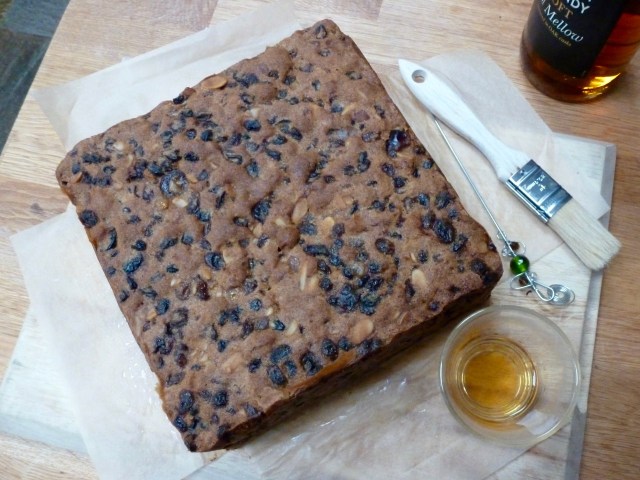
Friday food links – 12 Feb 2016

Camellia in the gutter. A casualty of yesterday's storm, a sign of spring.

This week has been powered by a big joint of pork shoulder that my mum slow-cooked on Saturday. It has been served with baked potatoes, in burrito bowls and in tortillas. It would have made it into pasta too if I’d remembered. I also made some freezer supplies for E: muffins to toast and banana date cakes. As it’s been a long time since a recipe featured anywhere on here, I’ve included the recipe for these below.

Recipes:

Without a recipe:

  • Pulled pork
  • Pasta with red peppers and mushrooms
  • Pork and black bean burritos
  • Pork burrito bowls
  • Slow cooker chicken curry
  • Carrot and sweet potato soup

Reading:

A bit light on reading this week. I’ve been working through Anne-Marie Slaughter’s ‘Unfinished Business’, on the challenge of the work-life balance and the low value we place on care.

Banana date cakes

Recipe: Banana and Date cakes

Adapted from a banana cake in the Baby Led Weaning Cookbook, these little cakes have no sugar, but are still sweet from the bananas and dates, especially if you use really ripe bananas. They make great toddler food, or a good breakfast or mid-morning snack.

  • 100g self-raising wholemeal flour
  • 1/2 tsp mixed spice
  • 50g unsalted butter
  • 2 very ripe bananas (200g peeled)
  • 1 egg
  • 75g dates

Prepare a muffin tin by greasing or with paper cases. Preheat the oven to 180C/160C fan.

Chop the dates. If they are somewhat dry, cover with hot water and leave to soak for about 10 minutes. Drain and set aside.

Rub the butter into the flour. Stir in the mixed spice.

In another bowl, mash the bananas and mix in the egg. Add to the flour with the drained, chopped dates and mix everything together.

Spoon into cupcake or muffin cases and bake for 15 – 20 minutes.

Behind the recipe: How to make Christmas cake

P1000568

A couple of weeks ago I made this year’s Christmas cake. I make my husband’s grandmother’s recipe, although, much to his horror, I do make some adjustments here and there. But it produces a fruit-packed dark cake that we both love, so it always seems worth it. And more than ever now we are a family of three, I enjoy the ritual of digging out the fruit in October, and making the cake, knowing that it promises cosy evenings and feasting to come in a couple of months. Even when all my good intentions of early Christmas shopping and house decorating come to nought, I feel comforted knowing that at least I have a cake stored away, that will make tea times feel festive.

Shauna from Gluten Free Girl wrote a lovely post earlier this year about the ritual of making the same food each week, of having a pattern to the week that everyone recognises. I feel the same way about these annual rituals of cooking. There is great comfort in a cooking ritual that evokes a specific time of year: marmalade in January, strawberries in June. But for a Brit, Christmas is the one time of year that we celebrate with specific festive foods. Americans have Thanksgiving, the Fourth of July, the Super Bowl to mark their cooking year. With Hot Cross Buns seemingly available all year round, Christmas is the last food feast in the calendar, even if it does seem to start in September.

When making a fruit cake for Christmas, there are certain rituals to the process that seem arcane. It seems to be a very complicated recipe, and it’s tempting to shortcut as many steps as possible. But why is the process so peculiar, compared to baking a straightforward sponge cake?

The main thing to remember about fruitcake is that it is (or should be) more fruit than cake. And dried fruit needs a few things to bake well: to be moist enough not to dry out; to be cooked slowly so that all the sugar in it doesn’t scorch; and to be suspended in a cake batter firm enough so that it doesn’t all sink to the bottom when baked. Here are some of the steps you might find in your Christmas cake or fruit cake recipe, and why they are worth doing:

Soaking the fruit

Many recipes start with measuring the fruit, and soaking it overnight (or for even longer). This plumps up fruit like raisins and currants, and the liquid they take in here will help keep the cake moist as it sits. And if you soak in brandy, rum, whisky or another spirit, it will also help to preserve the cake.

Wrapping the tin in brown paper

Using all my Blue Peter skills on the cake tin for the fruit cake

This is what really says Christmas to me. The idea when lining the tin with multiple layers of paper, and then wrapping newspaper or brown paper around the outside is to insulate the tin, and prevent the outside from browning, and ultimately scorching, before the centre of this dense cake is cooked through. You may also be asked to cover the top with paper, to prevent it browning too far.

Brushing/soaking with brandy/rum

This one definitely depends on how far in advance you’ve made it, and how often you remember to do this. It should serve two purposes – to help keep the crumb moist, and to further preserve the cake, and prevent any mould from forming. You should also make sure you wrap the cake well each time you do this, so that the moisture is kept in.

Wrapping in marzipan

So it’s been baked, and soaked, and wrapped, and it’s nearly Christmas. Just time to ice it. But first you have to cover it in marzipan and then let it dry out?? This is really a royal icing thing. The marzipan is there to stop the dark fruit of the cake from bleeding through the pristine white icing. And letting it dry out prevents oils from the almonds from leaking into the icing.

I’m not a huge fan of royal icing, or of shop-bought marzipan that is so sweet it makes your teeth ache. But I could be persuaded by Nigel Slater’s homemade almond paste with orange zest, and golden icing sugar icing.

Here is the recipe I use. The dried fruit can be varied, as long as you keep to the same weight. I like to keep a base of raisins and currants for their dark, rich flavours, but you may prefer paler, sweeter fruits: sultanas, figs and apricots chopped small, dried cherries. I have to confess that I no longer whisk the egg whites separately – I just couldn’t see how the air would survive folding in with the fruit. Instead I mix the whole eggs into the creamed butter and sugar. 

Recipe: Pendleton Christmas Cake

PREP TIME: 1 hr plus soaking

TOTAL TIME: 5 – 6 hr

This recipe – for 9 inch round tin (or 8 inch square) – 20cm square.

Ingredients:

  • 450 gram Raisins
  • 450 gram Sultanas
  • 340 gram Currants
  • 110 gram Candied Peel — finely chopped
  • 110 gram Glace Cherries — halved
  • 75 ml Brandy
  • 75ml orange juice
  • 110 gram Almonds, Blanched — shredded
  • 285 gram Flour, Plain
  • 1/2 tsp Salt
  • 1 tsp Ground Cinnamon
  • 1 tsp Mixed Spice
  • 1 pinch Nutmeg — grated
  • 225 gram Butter
  • 225 gram Sugar, Soft brown
  • 1 tbsp Black Treacle
  • 6 Eggs
  • 55 gram Plain Chocolate, melted
  • 1/2 tsp Bicarbonate of Soda
  • 1 tsp Warm water

Combine the fruit with the brandy and the orange juice. Leave to soak overnight.

Line tin with 2 thicknesses of baking parchment and tie a band of brown paper around the outside of tin that comes 2-3 inches above the rim.

Set oven at 300F/150C/130C fan or gas mark 3.

This recipe is in three parts: the cake mixture, the fruit, and the whisked egg whites. Each part gets a separate portion of the flour mixture until they are all combined at the end.

Sift flour, salt and spices together and divide into 3 portions. Mix one portion with the prepared fruit and nuts (especially coat the cherries well in flour).

Cream the butter in a mixer, or with a handheld mixer, then add the sugar and beat well until fairly light and fluffy (at least 3-4 minutes), then stir in black treacle. [To measure the black treacle, take the lid off the tin and stand it in hot water for a few minutes – this makes the treacle more liquid and easier to measure. Also, oil your measuring spoon with a little vegetable oil before scooping out the treacle- this will help the treacle to slide off the spoon]. Melt the chocolate in the microwave, or over a pan of gently simmering water. Stir in the melted chocolate.

Separate eggs, and whisk yolks together until slightly thickened, and add to butter mixture alternately with second portion of flour. Mix gently, so as not to overwork the flour and make the batter tough.

Fold the 1st portion of flour (mixed with fruit and nuts) into the cake mix.
Dissolve bicarbonate of soda in the warm water and stir gently into the mixture.

Whisk the egg whites until holding very soft peaks and fold into the cake mixture with the third and final portion of flour.

Turn cake mixture into prepared tin, smooth top with palette knife and brush with a little tepid water to keep cake soft while cooking. Put cake into oven and bake at least 3 and up to 4.5 hours. After the first hour, place a folded square of baking parchment on the top to reduce browning (this can go on from the beginning, but then tends to stick to the mixture).

When cake has been in the oven about 1.5 hours, turn cooker down to 290F (145C) or Mark 2. At the end of cooking time (or after about 3 hours) test with a skewer to see that it comes out clean with no batter clinging to it. Leave in tin to cool for 30 minutes then turn out carefully on to wire rack.

When cold wrap in several sheets of greaseproof paper and store in completely airtight tin. Store for at least one month. Will keep for a year or more. Cover with almond paste two weeks before needed and ice one week later.

More about making fruit cake, and some recipes:
BBC Food Fruit cake
Nigel Slater’s Christmas cake
Felicity Cloake on her perfect Christmas cake

Friday food links – 13 February 2015

Hurry up, Spring.

A short one this week, because I almost forgot to put this post together, and because I haven’t bookmarked that much this week. I’ve also been treated to someone else’s cooking all week, with my Mum catering while she was staying with us.

Reading this week:

Brown butter financiers or friands

Untitled

I sometimes come across this sort of silicone bakeware, and wonder what on earth it’s for (although if it’s as nice as this sunflower one, I don’t worry too much about that). But then I remember financiers. Financiers, or friands, are not something you often come across, but they are a great recipe to know about. Made with egg whites, melted butter, flour, sugar and ground nuts, they are moist little cakes that keep really well.

Financiers are from the French kitchen, and used to be baked in little gold-ingot like bars, which gave them the name. Traditionally, they would be made with brown butter and ground almonds – a rich and somewhat expensive combination which may account for the name. Friands are the antipodean version, less likely to include anything as fussy as brown butter, and more likely to be a carrier for raspberries, blueberries or other fruit flavours.

Another good reason to have a friand or financier recipe on hand is that they are a great way to use up leftover egg whites. Unlike macarons and other egg white recipes that use a meringue base, these don’t require the whites to be whisked to peaks. They only need a little whisking to break them up, and you can easily use 3, 4 or 5 egg whites for one batch of cakes (handy if you’ve been making ice-cream).

Untitled

Because of the melted butter and nuts, these are quite dense and rich little cakes, that are best baked in small tins. Friand tins are little oval shapes, but mini muffin tins are the perfect size, if you grease them well. You can also use silicon bakeware in lots of beautiful shapes, like this sunflower mould I picked up in Paris. This seems to cook them more evenly, although you also get less of the brown crust. When baked, the outside should be lightly browned, and when cool, just a little crisp. The interior will be rich and dense with the nuts.

They are a great thing to have on hand if you think you don’t want a proper dessert or cake, just something sweet to nibble with tea or coffee at the end of a meal, or as a pick-me-up in the middle of the afternoon.

For these sunflower cakes, I wanted to keep the mixture plain – no berries or other decorations, so that the shape of the sunflowers would show up nicely. Instead, I used the traditional French approach and made brown butter, which along with a little vanilla, formed the only flavouring. There will be more on alternative flavours for financiers in a forthcoming post.

Scroll down for more on what’s behind the recipe, including details on brown butter and the role of the egg whites.

Brown butter financiers

  • 150g brown butter
  • 165g egg whites(5)
  • 175g icing sugar
  • 50g plain flour
  • 100g ground almonds
  • 1 teaspoon vanilla extract

First make the brown butter, as directed below, and set aside to cool.
Preheat the oven to 200C/180C fan/400F and thoroughly butter your moulds or tins.
Whisk the egg whites gently to loosen them, but not enough to create a froth. Sieve the icing sugar, flour and almonds onto the whites and stir together until combined.
When the butter has cooled but is still liquid, add to the mixture and fold together gently until completely combined and homogenous. If you like, add some vanilla extract or a drop or two of almond extract.

Untitled
At this stage, you can refrigerate the mixture overnight or for a few days, until you are ready to bake.
Fill the moulds about 80% full, and bake for 8–12 minutes. The timing will depend on the tins you are using – both the material and the size. They are ready when cooked through – test with a skewer – and with toasted brown edges.
Leave to cool for 5–10 minutes and then turn out of the tin while still warm. If using metal tins, you may need to use a knife to ease the cakes away from the sides. Eat the same day if possible – although they will keep for several days in a tin, the texture won’t be quite as good, and you won’t get the same contrast between crisp edge and soft, dense interior.

What’s behind the recipe?

Brown butter

Untitled
Brown butter is what happens when you cook butter until the water has all evaporated and the temperature rises high enough to toast the milk solids in the fat. This produces a little bit of brown sludge at the bottom of the pan, and a lovely toasty, nutty flavour in the butter. It’s sometimes called beurre noisette, and used as a sauce in some dishes of French cookery.

You may have made brown butter accidentally before, by putting butter into a too-hot pan, and seeing the little brown grains appear. Brown butter, made deliberately, is usually done in a small saucepan, of pale metal so that you can see the browning, with a larger quantity of butter. Melt the butter over a moderate heat.

Once the butter is gets close to 100C the water in the butter will start to boil (about 15% of butter is water, depending on the brand you use). Let this bubbling continue. When the water has all gone, it will stop bubbling, and go quiet. This is when you need to pay close attention, and probably stir occasionally. The milk solids – those white, milky parts that appear when you melt butter – will sink to the bottom of the pan and be the first to brown, so you need to scrape them off and stir them about to make sure nothing burns. You might also start to get a foam on the top of the butter. Once the solids at the bottom are a nice nut-brown, and the whole thing smells nutty, remove it from the heat and pour the whole thing into a heatproof bowl or measuring jug. This will help to stop the cooking and make sure it doesn’t brown any further and start to burn. Most recipes using brown butter, including financiers, will need the butter to be cooled – it will be extremely hot when it comes out of the pan.

Why whisk the egg whites if you’re not going to form peaks?

Financiers don’t need the aeration you get from an egg white whisked into snowy peaks, but the recipes often ask you to whisk them a little. Why? The proteins in egg white attach to each other very well, which is why a really fresh egg broken onto a plate will ‘sit up’, and why it’s so hard to divide an egg white in half, if you’ve ever tried to do that. Whisking the whites just a little helps to break apart the proteins and loosen the whole thing up. This makes it much easier to mix in the other ingredients.

Why do financiers only have egg whites in?

Financiers are a puzzle to me. Here is a little tender cake, that doesn’t have any baking powder in, and doesn’t whisk air in through creaming or whisked egg whites. So what makes it rise instead of being a flat pancake?

My best guess is that the egg whites provide a stretchy protein structure, so that when the water and fat in the recipe heats up, and steam is released, the stretchy egg proteins are there to capture it and keep the bubbles in the final cake. There is very little flour in the recipe, so the egg white proteins are likely to be contributing most of the structure that holds the cake together. Ordinarily, egg whites create quite dry, crisp things, but all those nuts and butter keep things rich here.

Some other great friand recipes:

Making late-night birthday cake

Or How to bake a cake between 9:30pm and 11pm

Cutting the cake

There is something quite sad about supermarket birthday cakes. Don’t get me wrong – I’ve certainly bought them before now – but it’s just not the same as a homemade cake. There’s a particular large supermarket that sells a rectangular sheet cake, decorated with sweet chocolate buttercream and stars that often makes an appearance at my workplace. It looks so promising, with swirls of icing along the edges, but it always seems disappointing. The sponge is damp and collapses easily. The icing is gruesomely sweet. Even the chocolate stars on the top are have that waxy quality, more cake covering than chocolate.

I am an unashamed snob about birthday cakes. They need to be homemade, or from a good bakery. It’s not a celebration if the cake is going to coat your mouth, give you a sugar crisis, and is made of palm oil and emulsifiers. And it’s not too hard to come up with something better than those options.

Rectangular tins are perfect for low-hassle birthday cake. No complicated turning out or layering, just leave it in the tin, cover with frosting and then pop the lid on to take it to the birthday destination. I have an old traybake tin from Lakeland that I tried for the first time the other day. Although the tin is a little thin, and the non-stick looks a little fragile, its killer feature is a plastic lid with a handle that clips onto the edges for transportation. But even without a bespoke lid, if the tin is deep enough to allow the cake and icing to sit below the rim, the whole thing can be wrapped in cling film (plastic wrap) for transport.

It’s even possible to make a birthday cake if you’ve been to the pub after work and don’t get home until a bit late (as long as you’re fairly sober). Here’s how to make a late-night birthday cake:

  • Get in the door at 9:20pm
  • Immediately switch on oven, and get butter out of the fridge. Cold butter and sponge cakes don’t work well together.
  • Find Smitten Kitchen’s cookbook because you remember she has a sheet cake recipe in there (basically this one, but scaled down).
  • Find the weight of butter needed, and weigh it onto a plate. Put this into a microwave for two minutes on the lowest, lowest setting so it can soften.
  • Go back to the book and check that you really do have all the ingredients called for before you go any further. Yes, it seems OK. The only tricky one is buttermilk, but that can be taken care of with the last of the yoghurt, combined with some milk.
  • Dig out your traybake tin and check it is roughly the right dimensions. 20 x 30 cm is a typical size for a traybake recipe, but after last week and the coconut cake, I want to make sure this is deep as well. Put a piece of parchment paper in the tin – not only to stop sticking but to protect the non-stick from scratching when the cake is cut!
  • (Remember you haven’t had dinner yet, and re-heat the leftover curry)
  • Prepare the rest of the ingredients: whisk flour with the baking powder and salt in a bowl. Get the eggs from the fridge and immerse in a little bowl of warm water from the tap – everything as close to room temperature as possible. Whisk the yoghurt and milk together in a jug to make them smooth.
  • Once the butter is soft, add it to the bowl and mix it a few times to make sure it’s creamy. Weigh the sugar straight into the bowl and set the mixer running for a good five minutes or so. The mixture needs to become pale and fluffy, not sandy, and as there’s a lot of sugar in proportion to the butter, this takes a while. Don’t rush this bit – everything else is easier if you get this right. Go and eat dinner.
  • Once you have this fluffy state, add the eggs one by one (drying them so they don’t drip into the bowl). If you’re sensible, you would crack them into a cup or ramekin first, to make sure you don’t get shell in the mix. (I go for speed and crack them straight over the mixing bowl.) Mix in one at a time, until you get back to that fluffy looking mixture. Add the vanilla.
  • Now the job is to get in all the flour and the yoghurt/milk without either a) overworking the mixture once the flour is in, b) leaving big patches unmixed, or c) having it all curdle. A good rule is to alternate the two – one third of the flour; mix; half the liquid; mix; one third more flour; mix; rest of the liquid; mix; rest of the flour. This makes sure that nothing overwhelms the mixture at any one time.

Fluffy cake mixture

  • Once it’s all in (and you’re sure that you got the edges of the bowl mixed in too), scrape it all into the tin, smooth to the corners and bake. By now it’s about 10pm.
  • While the cake is baking, make some icing. The treacle chocolate fudge frosting on this page is a good option (I made it without the yolks and water, and with creme fraiche and 2 tablespoons extra icing sugar added). It uses a base of cornflour-thickened chocolate custard, with more chocolate mixed in while warm. Cover and leave until the morning. A simple buttercream of butter and icing sugar would also work.
  • When the cake is evenly golden on top, and a cocktail stick comes out clean, take it out and put onto a cooling rack. After about 10–15 minutes cooling in the tin, turned it out to cool, leaving the parchment still on the bottom. Leave to cool overnight and go to bed.

Frosting ready to spread

  • In the morning before work, put the cake back in the pan (the parchment will help). Beat the icing to make sure it’s smooth and spreadable. Scrape all of the frosting on top of the cake and spread it out with a spatula. Add sprinkles and other decorations if you want. It’s too early for piping.
  • The leftovers

Drømmekage – dream coconut cake

A slice of Drommekage

Drømmekage is a genoise sponge beneath a layer of coconut caramel – a plain cake made glamourous with a baked-on topping. This one is from a recipe by Signe Johansen, from her cookbook ‘Scandilicious’. It belongs to a class of Scandinavian baking that seems to be closely linked to German traditions of Kaffee and Kuchen – Swedish Toscakaka and German coffee-cakes with streusel toppings. There is a Danish word for the togetherness of coffee and cake, hearth and home: hygge. (It also appears on this excellent map of untranslatable non English words. These are cakes designed to be sliced and shared through an afternoon, not squirreled away in a tin for later. It was certainly devoured by my work colleagues last Friday, and generated not a little happiness.

A cake with a baked-on topping is a great thing. A plain cake, but with a little something extra. They strike a nice balance between the slight austerity of a very plain Madeira or pound cake, and the over-the-top elaborateness of a piled high cupcake or layer cake. Whether its flaked almonds on top of a bakewell tart, or a handful of granola on the top of a muffin, they provide not just decoration but a contrast in texture and flavour.

In this cake, the cake is too delicate to add the topping before it is baked, so the solution is to bake the cake, then add the topping and bake again to brown it and merge it with the cake beneath.

This makes it especially important to know when the cake is done – adding the topping too early will (as a Danish colleague warned me) sink the cake, collapsing the sponge into a dense layer. It’s also important to recognise when the caramel is thick enough to top the cake without sliding off.

I’ll give you the recipe, reproduced with very kind permission from Signe’s book, then discuss what’s happening behind the recipe – what are the critical steps?

Drommekage - Danish coconut cake

Drømmekage – Danish Coconut Dream Cake

from ‘Scandilicious – Secrets of Scandinavian Cooking’ by Signe Johansen, Saltyard Books
(and if you like this and live in London, you should definitely consider attending Signe’s Scandi brunch and supper club).

  • 4 medium eggs
  • 300g golden caster sugar
  • 1 teaspoon vanilla extract
  • 150g butter, melted
  • 150ml buttermilk (or a mixture of yoghurt and milk)
  • 300g plain flour
  • 3 teaspoons baking powder
  • 1/4 teaspoon salt

Topping
– 200g butter
– 200g light brown soft sugar
– 150g dessicated coconut
– 100ml whole milk
– 1 heaped teaspoon vanilla sea salt (I used a scant teaspoon sea salt plus half a teaspoon of vanilla bean paste)

Preheat the oven to 190C/170C fan/gas mark 5. Line a 20x30cm deep rectangular cake pan with parchment paper, leaving a 2 inch overhang to help remove the cake later. It helps to have the paper extend above the sides of the tin a little to contain the topping later.

Melt the butter and leave to cool a little. Combine the flour, baking powder and salt in a bowl, and mix with a whisk to distribute the baking powder.

Using an electric mixer beat the eggs, sugar and vanilla together until thick and pale, the batter should form a ribbon when the whisk is removed from the bowl. This will take several minutes on high speed. If you’re not sure whether it’s thick enough, give it another minute.

Pour in half the melted butter and buttermilk and sift half the flour onto the batter. Fold the batter together with a large metal spoon, trying to incorporate as much of the flour, butter and buttermilk without knocking out the air from the eggs.

Pour in the remaining butter and buttermilk and sift over the remaining flour. Fold the batter as above.

Pour the batter into the prepared cake pan and bake for 20 minutes or until the cake has doubled in size, looks light golden brown in colour and is firm to the touch. A toothpick inserted into the cake should also come out clean. You want to be sure it has baked thoroughly and will bear the weight of the topping to come.

Whilst the cake is baking make the topping by adding all the ingredients into a medium saucepan set over medium heat, stirring constantly to prevent the sugar from burning. Cook for 5 minutes until the mixture has thickened and some of the liquid has evaporated. It will reduce a little and also change colour to a slightly darker shade of brown. You want something thick enough that it will spread over the surface, and not run too much.

Once the cake is out of the oven turn the temperature up to 220C/200C fan/gas mark 7. Spread the topping evenly over the cake, return to the oven and bake on the upper-middle shelf for 5–10 minutes until the topping is a toasted deep golden colour (I found this step took more like 15–20 minutes in my oven). Cool in the tin before cutting into squares to serve. As the topping had set into a lovely chewy caramel in some places, I found it easiest to turn it over onto a board, topping side down, and slice with a serrated knife.

Behind the recipe

So what’s going on behind the recipe? Where are the critical steps? I think there are four steps that are particularly important:

Whisking the eggs well enough to support the rest of the cake

What makes this a genoise-type of sponge is that it is based on a first step of whisking the eggs and sugar together until thick, rather than the more usual process of creaming together butter and sugar. This thick mixture is known as ‘taking it to the ribbon stage’, as the mix should form a thick ribbon as it trails down from the whisk into the bowl. Once this is done, the other ingredients – in this case, flour, melted butter and buttermilk – are folded in.
Eggs and sugar whisked together – whether just egg whites or whole eggs – will form a pretty stable foam that can hold lots of air, even when deflating ingredients like butter and flour are folded in. It’s almost impossible to over whisk eggs once a substantial amount of sugar has gone in, so if you want to err on the safe side, just keep going with the whisk a bit longer. This is one of those times where you will give up your right arm for an electric mixer – the handheld ones work really well and are not expensive. I used my Kitchenaid with a whisk attachment.

Baking until firm enough to support the topping

In order to support the caramel topping, it’s important to bake the cake until all trace of liquid cake batter has disappeared, and the cake is fairly firm. The recipe gives the baking time as 20 minutes, but given all the variations in oven temperatures and baking tins, you should always check for doneness before the time is up, then at five minute intervals until it looks close. The first thing I check for with a sponge, whether genoise or creamed, is whether you can still see a wobbly lake of batter in the centre. If a gentle shake of the tin reveals there is still a puddle under the surface you can safely give it another five minutes. Once that has gone, you might want to check more frequently with either a skewer, cocktail stick or small paring knife to see that crumbs rather than liquid batter sticks. To test whether it is firm enough to support a topping, lightly pressing the surface with your finger, to see if it will resist and spring back, is another good test.

Cooking the caramel on the stove

The recipe asks for the caramel mixture to be cooked in a saucepan before adding it to the cake. Caramel is a really temperature sensitive thing, and the thing to know about caramel temperatures is that it won’t start to rise much above 100C until almost all the water is removed from the mixture. This is (I presume), why the mixture is first boiled on the stove – to remove most of the water, and create something that will readily form a set caramel in the oven. I found that the volume reduced quite a bit, and the colour changed from a pale gold to a darker shade.

Baking the caramel to caramelise it further

The aim of this final stage is to convert the sugar from a runny caramel to a chewy toffee-like topping. This means baking it in the oven long enough to caramelise it further and ensure it sets in place. I had difficulty with this stage, as my tin wasn’t deep enough, and as it baked, the topping overflowed the paper lining and spilled over into the oven. Having a very even surface to the cake will help make sure the topping browns evenly, and if you know your oven has some hot spots, keep checking and turn it around periodically, so that it evens out (I put my tin on a baking sheet at this stage to catch any overflowing topping, and also to make it easier to turn around).

100 years young – making Swiss buttercream

Buying a 100th birthday present is a difficult task. Any birthday present purchase can present problems, at least for me. I want to make sure I get it right. Something that will be valued, something that will be loved. Something that will last.
A present for someone completing a century on the planet is a little different. Concepts like ‘lasting a lifetime’ take on a completely different hue. It’s almost impossible to get something useful that they don’t already have. Beautiful things seem trivial, ephemeral.

When my gran, my closest and only surviving grandparent, turned 100 a few weeks ago, I wanted a gift to express love, but just buying an expensive thing doesn’t cut it with grandparents.

photo-10100

Born in 1912, the year of Titanic, she went to Jersey to celebrate her 21st birthday in 1933, hanging out with chaps in blazers and lasses in swimming costumes. Her older brothers fought in the First World War, and her husband in the Second. She was a smart and funny white-haired lady when I was born, her first grandchild, and she still is. She’s an incredible woman, as sharp and funny as ever, and coming up with a suitable gift was daunting.

We gathered as a family for a weekend of celebrating – dinners, lunches and finally an afternoon tea with cards and presents. I bought her a painted silk scarf so there was something to unwrap. But I think my main contribution to the weekend was helping with the birthday cake.

This was a real joint effort between my mum, my sister and me. Although it needed to be celebratory, and bear decoration, she didn’t want either chocolate cake or fruit cake. As she doesn’t have much of a sweet tooth, we went for lemon sponge, but that posed the question of how best to decorate it.

Having done a bit of research on smitten kitchen and sweetapolita, I decided what we really needed was Swiss buttercream. The reason for using this is that it is very stable, and can be made ahead; it is not too sweet and sickly, unlike quick buttercream or fondant; and it can be made into a smooth surface to support piped icing decorations.

Swiss buttercream is made of a mixture of meringue and softened butter. The meringue is made using the Swiss method, dissolving the sugar into warmed egg whites before beating (as opposed to the French method:whisking sugar directly into whipped egg whites; or the Italian: pouring a hot sugar syrup into whipped egg whites).

You begin by measuring the sugar and egg whites into a large heatproof bowl. I used egg whites from a carton – I know there are virtually no problems now from British eggs, and you are heating them in this recipe, but I didnt want to take any chances with a 100 year old consumer. In any case, the carton whites (available as Two Chicks in a number of supermarkets in the UK) are very convenient for weighing out a precise amount.

This mixture is then heated over a barely simmering pan of water, stirring constantly, until it reaches 60c and the sugar has all dissolved into the whites. You can check this by rubbing the mixture between your fingertips to check that all the gritty sugar crystals are gone.

Then the warmed egg white syrup is whisked into stiff meringue peaks. We made two batches of the buttercream, fearing that my mum’s handheld electric mixer might not handle a full batch. Neither batch reached stiff peaks at this stage – both were still flowing a little, one more than the other, although the mixture was quite thick and opaque.

Ribbon

We pressed on anyway, despite the lack of stiff peaks, and it turned out fine. I don’t think there was any difference in texture between the two final batches. The process of adding the butter tends to deflate the mixture at first anyway. As long as the mixture is very thick and holds a ribbon, it should still be fine, even without peaks.

Once the meringue is thick, and has cooled to not far above room temperature, you can start to whisk in the butter. The butter should be cubed and a room temperature, so you can easily create an impression in it with your finger, but not so soft it starts to get shiny and greasy.

Whisk in one cube at a time. The mixture will deflate, and become thinner, perhaps quite soupy. It might also split and curdle. Keep whisking and adding butter. Once the butter is almost all incorporated, the texture suddenly changes, and it snaps to a thick mixture, that holds its shape very cleanly.

Untitled

This can be kept in the fridge for several days, or frozen. When chilled, the texture is much like that of butter – quite firm and almost waxy. For this reason, you should make sure cakes frosted with Swiss buttercream are served at room temperature. To bring the the buttercream back to a working consistency, bring it slowly to room temperature, or give a couple of very low power bursts in the microwave, just as you would do when softening butter from the fridge. To help the process along, return the batch to a bowl and use an electric whisk or stand mixer to whip the buttercream until it is soft and spreadable again.
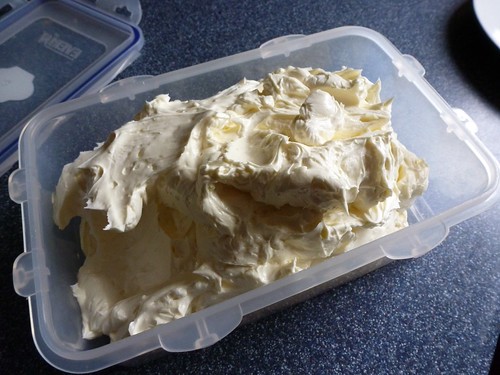
Buttercream in a box

For the final cake, we layered my mum’s 8 inch square sponge layers, flavoured with lemon zest, with most of a jar of bought lemon curd.

Untitled

I trimmed the edges square, and covered the cake with a crumb coat of buttercream. After chilling for about an hour, the cake surface was firm, like a block of cold butter, and we could layer on the rest of the buttercream.

Untitled

Starting at the sides, this task looks a lot like plastering – apply a decent sized blob, and smooth it to an even layer. The great thing about Swiss buttercream is that it can be spread and smoothed out many times, and it will hold its texture. After covering it with a more or less even layer of frosting all over, I used a long palette knife to drag along the sides and over the top to make the surface as smooth and flat as possible. Then the cake went into the fridge overnight.

Untitled

The next morning, we mixed up some fairly thick royal icing with yellow colour paste, and my sister, practiced from many school holidays working in a Thorntons shop, piped 100 on the top of the cake, and scrolls in the corners.

The final touch was to add my mum’s crystallised primroses, made with flowers from her garden, brushed with egg white and dusted with sugar.

Cake

DSC_0268

The final cake went down well – it was moist in the centre, not too sweet. And a fitting cake to bear candles for a 100 year old to blow out.

Untitled

Cake baking – more cake foundations

In the last post, I looked in detail at creaming the butter and sugar, the starting point for many cakes. This post follows what happens next – adding the eggs, flour and then baking.

Fairy cake inside

I found a great description of what happens in a cake in Rose Levy Berenbaum’s Cake Bible:

“Ingredients fall into two categories: those that form and strengthen the cake structure and those that weaken it”.

The flour and eggs provide the protein that holds the cake structure up, and stop it from collapsing into a pancake. The fat, sugar and leavening all weaken the structure in different ways, making the cake tender and soft instead of tough and chewy. The balance between the two sides is important for capturing the air that makes cakes soft and light.

Adding eggs – what happens when it curdles

Almost as soon as I put the last post up, someone asked what happens if the mixture curdles. I have looked into this problem before – most people seem to say it can be avoided, perhaps marginally reduces the volume of the final cake, but if it does happen, you can carry on without problems.

But what was unclear was what caused it to curdle in the first place – was it really not enough creaming, or something else?

Curdled mixture with eggs

When the mixture curdles, what you see appearing are lumps of fat and sugar, surrounded by a thin watery liquid. The clearest explanation I found came from Shirley Corriher in ‘Bakewise’. She describes this as a:

“switch from the the water-in-oil emulsion that you want to an oil-in-water emulsion”.

This probably only makes sense if you know what an emulsion is. An emulsion is simply one liquid suspended in another. In this case, when you start to add the eggs, you are aiming for little droplets of the water from the eggs, suspended through the fat-and-sugar mixture that is already there. At some point, the liquid from the eggs can overwhelm the amount of fat, causing the bubbles of water to all join up and become the main part of the mixture – the continuous phase, as it’s called.

To prevent this happening, you need to ensure that the fat and sugar are able to hold as much liquid as possible – which means soft, but not melted. You also need to add the egg very gradually, so that it doesn’t overwhelm the mixture. This is the same principle as adding oil to mayonnaise – go slowly and incorporate each bit before you add some more.

Finally, the solution once it has curdled – which it might well do – is to stop beating it and add some flour. This will absorb the excess liquid that’s starting to pool, and shift the balance back again.

With flour added

Speaking of Shirley Corriher, this is a brilliant excuse to link to my favourite food science programme, Good Eats:
Good Eats: A Cake on Every Plate

Shirley appears at about 4m30 (disturbingly extolling the virtues of cake flour, which you can’t get in the UK because it’s chlorinated, and the EU aren’t big fans of that idea).
Alton also talks about creaming and bubbles at about 8m30. He also has kick-ass flames painted onto his KitchenAid mixer.

Adding flour

Once the eggs are in, the final step is to add the flour, and any liquid that might be called for. These are often added in alternate batches, so that the mixture gets neither too stiff nor too runny as they go in – either might deflate the air.

An often neglected step is to thoroughly sift the flour and baking powder together. This isn’t necessary if using self-raising flour, but when adding baking powder, there is always the risk that small lumps of leavener will persist in the batter, and produce large ugly holes in the final cake. If you really want a fine texture, sift two or three times before it goes into the batter.

The other important thing when you add the flour is to stop folding or stirring as soon as the flour has disappeared into the mixture – don’t mix any more than you need to. As soon as the flour makes contact with the liquid in the eggs, and any added liquid like milk, it will start to make gluten. The more you mix at this point, the longer and stronger the gluten will become, and the tougher your cake will be.

Baking

The final point is on baking. The balance here is between allowing the leavener time to work and expand, and setting the egg and flour proteins in a structure that will hold the air. Bake at too high a heat, and the leavener might not have had time to work before the batter sets, making a more dense cake with a closer texture. Bake at too low a temperature, and the gas might bubble to the surface and disperse, and so be lost that way. A medium temperature will set the batter at the right point, and bake through evenly without making the surface too dark and brown.

An alternative method – the two stage approach

When consulting Rose Levy Berenbaum, I discovered that she actually doesn’t recommend creaming at all. Her favoured approach is a different one completely. She combines the flour, sugar and fat together with a little egg, and beats thoroughly to incorporate air. Then she adds the remainder of the egg, and other liquid in batches.

This approach takes a different route to the issues above. By combining the fat directly with the flour, it can be coated to prevent the liquid getting at the protein and forming gluten. The flour-sugar-fat mixture can still hold air, so the creaming still generates volume. And the eggs are added only once the flour is already there to absorb liquid, so there is no risk of curdling.

I haven’t tried this approach more than once or twice, but I will be trying it out alongside regular creaming to see what effect it has. Watch this space.

Creaming – the foundation of cake making

Baked until golden

Cakes are demanding, and learning to make a good cake needs more than a recipe. So many little details are important. One of the essential details, at least for most British cakes, is beating the butter and sugar until truly pale and fluffy – creaming them together. If you’re making a Victoria sponge, a layer cake or a cupcake, you almost always start by creaming together the butter and sugar.

What is creaming?

For a long time I didn’t understand creaming at all. The recipe phrase is usually ‘cream the butter and sugar together, or ‘beat until light and fluffy’ or ‘beat until it turns a shade paler’. The big problem with these directions is that they don’t convey the change you need to see. You start off with a greasy paste of butter and sugar, but end up with something more like slightly yellowed whipped cream instead of butter.

Creamed butter and sugar

I only really got creaming when watching a demonstration by Alice Medrich, an American baker and chocolatier. She was making her Tribute cake, a layer cake of featherlight chocolate sponge with whipped chocolate ganache filling and a smooth, shiny chocolate glaze. She left the mixer running for a good five minutes when creaming the butter and sugar – much longer than I had expected.

Think about it this way instead: most of the frosting that is now applied in towering heaps to American cupcakes is made of this same mixture. They tend to use icing sugar instead, so the texture is even smoother, but the volume and the fluffy texture are the things you’re aiming for.

Why is creaming important in making cakes?

Cake texture

The structure of a cupcake is a foam, a web of flour starch and egg proteins, with many tiny bubbles. The batter you end up with is quite delicate, with just enough connection between the ingredients to hold the all-important air in there. This is the biggest difference between a sponge and other types of cake.

Marrying butter and sugar is a task at once completely simple and immensely complicated. It is the foundation of cake bakery, the structure upon which everything else stands. Build it carelessly, and the rest of the structure may wobble and fall. Of course, you can insure yourself against these errors with other supporting structures, but when you want to move on to the virtuoso pieces that really depend on the foundation, that strip everything else back, you will find it hard.

What is happening when you cream together butter and sugar is that the sugar crystals are helping to create bubbles in the fat as they are beaten. Air is what creaming is all about. Beating faster and longer creates more and more bubbles, and creates a finer texture. Any time you introduce bubbles of one thing into something else, it will become more opaque and paler. This is true of vinaigrette, of hollandaise, of whisked egg whites and of creamed butter and sugar. All the little bubbles start to interfere with the light, bouncing it around more and making it look paler.

How do you cream butter and sugar for sponge cakes?

Hannah Glasse in 1774 described the final state as a ‘fine thick cream’. She suggested that using your hand, this should take an hour. Another 19th Century book suggests it is “the hardest part of cake making” and you should have your manservant do it.

In the absence of a man-servant, a handheld electric mixer or a stand mixer like a Kitchenaid makes this much, much easier. With a small quantity it can be done by hand, but expect a decent workout. You need the mixture to change colour – as the air is incorporated, the bubbles make the mixture look paler. The texture also becomes much fluffier.

Creamed butter & sugar

When you’re creaming butter and sugar together, it’s more or less impossible to mix for too long. You at least need the mixture to become one shade lighter. By mixing it for long enough, it should be possible to make it turn almost white, as the sugar crystals introduce more and more air into the fat. All of this isn’t really conveyed by the simple words ‘cream the butter and sugar’.

In a follow up post, I’ll talk about the subsequent steps in making a sponge cake, which follow on from the creaming step.

Beginning to bake #9: Apple and blueberry cake

Finished cake

I wanted to finish this series with another cake – a bit of an occasion cake that you could make for a birthday or dinner party. The obvious choice is a Victoria sponge, which you can make plain or chocolate, and fill with buttercream. But to be honest, you just need to follow the cupcakes recipe from this series, double it and bake it in two 20cm sandwich tins. Very easy.

Instead, I wanted to explore one of the best things about baking – experimenting.

Experimenting with food

One of the joys of baking is that you can play around and invent your own recipes.  There are some rules to be followed, and weighing accurately is important, but the rules create a framework that you can work within to be creative. Once you understand what’s going on in a recipe, and the ratios that  make things work, you *can* play around with baking recipes. Understanding that is really liberating and opens up a whole creative world.

To do this successfully, you need to understand which elements are important to the structure of the cake, and which you can safely play around with.

This weekend, I made a cake with fruit baked into the top. This can be pudding, with custard or creme fraiche, a cake for afternoon tea (or even a late breakfast). It doesn’t require filling or icing, and can be served warm, so it’s a great last-minute option for dinner.

The recipe I started with is from Donna Hay’s book, ‘Off the Shelf’ – a book about cooking from the pantry. This one, and several earlier Donna Hay books are hard to find now in the UK, but they are really lovely. Donna is the Martha Stewart of Australia (but nicer than that sounds). She is a great food stylist and photographer as well as a cook, so all her books and her  bi-monthly magazine are beautiful, with big pictures of all the dishes.

This recipe is for a peach and raspberry tart with a sponge base. The original recipe is as follows (converting the cup measures to grams):

  • 125g butter, softened
  • 225g caster sugar
  • 1 tsp vanilla extract
  • 2 eggs
  • 185g self-raising flour
  • 2 peaches, halved and cut into thin wedges
  • 150g raspberries
  • 2 tablespoons icing sugar

[You can find the full recipe (American version) here: http://articles.nydailynews.com/2002-06-02/entertainment/18194663_1_raspberries-tart-peaches]

Just looking at the ingredients list, and the order they are presented in, I can guess  at the method and which ingredients I need to leave alone. And the method confirms this – you cream the butter and sugar together until fluffy, add the vanilla and eggs, mix the flour in gently, and then top with the fruit when the mixture is in the tin.

In a recipe like this, the ratio of the butter to sugar to flour to eggs is important. With enough knowledge, you can start playing with this too, but it’s much harder to get right.

The bits that you can safely play with are the fruit, and to a certain extent, replacing some of the flour.

For the fruit, the main thing to bear in mind is making sure that the fruit you use releases a similar amount of juice, or the finished cake could be either too dry or too soggy. Strawberries, for instance, are very juicy and get very wet when cooked. Apples and pears release much less liquid. Stone fruit such as peaches and plums, and berries, are somewhere in between.

So when I decided to replace peaches with apples, and raspberries with blueberries, I was confident that the blueberries would behave in a similar way to the raspberries. However apples give up less juice and need more cooking to become soft than peaches. I solved this problem by gently cooking the apple slices in butter before putting them on top of the cake. This made them slightly softer, giving them a head start in the cooking. They were cooked just until starting to become translucent, but still firm enough to hold together in slices.

If you did end up using much juicier fruit, you can compensate by adding something more absorbent to the flour – cornmeal, polenta, semolina will all absorb more liquid (that’s a good trick for pastry with fruit on top as well).

For this cake, I wanted to add both moisture and a different flavour by adding ground nuts to replace some of the flour. Ground nuts have a good deal of oil in them, so they don’t behave exactly like the flour. They won’t provide the structure that flour would, so the cake may sink more (although with fruit on top, this one won’t rise very high anyway). It will also keep the cake nice and moist as it keeps. I was going to use ground almonds, but then saw ground hazelnuts on special offer after passover, so used them instead.

So the final recipe I ended up with is as follows:

Apple, Blueberry and Hazelnut cake

Recipe adapted from Donna Hay’s Off the Shelf.

Oven preheated to 180C/160C fan.

  • 2 apples (Braeburn), cut into thin wedges,

— Gently fried in butter until they have softened slightly and lost some of their opacity. Put aside to cool.

Cooked apples

  • 125g butter, softened
  • 225g caster sugar
  • 1 teaspoon vanilla extract

— all beaten together in the KitchenAid until light and fluffy

Creamed butter & sugar

  • 2 eggs

— beaten together, and then slowly beaten into the creamed mixture

Added egg

  • 145g plain flour (forgot about the self-raising part, and it was fine!)
  • 45g ground hazelnuts

— added to mixture and mixed just to combine.

Flour and ground hazelnuts folded in

Scraped all of this into a lined and greased 9 inch/22cm springform tin.

Batter spread in pan

Arrange the apples on top and sprinkle over a carton of blueberries (around 150g – 200g).

Apples onto cake

Add blueberries

Bake for 1 hour, until the cake risen between the fruit is golden, and springs back. You can also use a skewer to test for crumbs, but pick a point in between the fruit.

Put on a rack to cool, and sprinkle with icing sugar before serving.

Finished cake

The final cake is firm and moist, slices cleanly and supports the fruit without it sinking through. It’s perhaps a touch on the sweet side, so I might consider experimenting with reducing the sugar in future. That is the sort of thing you want to do gradually, as you will affect the ratio of the cake.