Friday food links – 10 Apr 2015

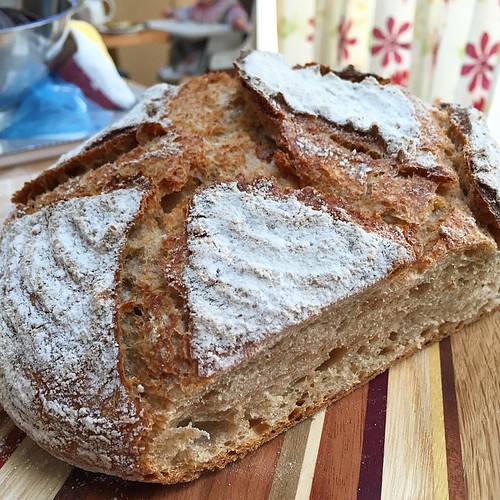
Yesterday's no knead bread, this morning's toast.

I’m now into the last two weeks of maternity leave, so this has been a week of firsts, lasts and letting go gradually. I am going back to work three days a week, so there will still be time for swimming lessons, walking to the park to see the ducks, and just lazing around on the living room rug. But it’s hard to ignore the fact that that our lives will necessarily be more planned and regimented from now on. Getting us both dressed and out the door for 7:30am, getting dinner on the table for us both, and organising shopping and deliveries will all be more challenging from now on. Considering a slow cooker, but also knowing that this is not a magic solution.

Fortunately, our last full week of freedom has been warm and sunny. We bought new shoes, went to Kew to see the magnolias in full bloom, rode around the supermarket in the trolley, and played on the swings in the park. The biggest hit with E for dinner (and lunch) was a very mild chicken curry with lentils and cauliflower. She’s been sucking it off bread, eating it by the spoonful and even getting her hands in the bowl and shovelling it in with her fingers. Our sea bass, potatoes and broccoli were summarily rejected in favour of more curry. I’ve also been hunting for some more prepare-ahead baby-led weaning options for when my preparation and imagination fail me (and pinning things I find here). Food52’s Cooking for Clara column is a good one – I made these baked beans this week.

Recipes:
* Earl Grey and Honey tea loaf – Justin Gellatly’s Bread, Cake, Doughnut, Pudding
* Moroccan carrot salad – Diana Henry’s A Change of Appetite
* Baked beans – Food 52
* Chicken stir-fry and broccoli with ginger – Fuschia Dunlop’s Every Grain of Rice (a library one this, but I think I may have to buy it myself – see also Sassy Radish on this book).
* Chicken Adobado – Thomasina Miers’ Mexican Food Made Simple
* Banana cake for First birthday monkey cake in a couple of weeks – Smitten Kitchen recipe

Without a recipe:
* Chicken stock
* Chicken curry, loosely from the Baby Led Weaning Cookbook
* Saucy Fish sea bass, with new potatoes and purple sprouting broccoli
* Burgers and wedges

Reading:
* This piece on food in Homer, Alaska is a wonderful piece of writing, and is nominated for a James Beard journalism award (via Orangette)
* Apparently merveilleux are the new macarons
* Baking a cake for the first time can be daunting – here a cook (but not a baker) shares her worries
* The head chef at Yotam Ottolenghi’s Nopi restaurant left to be a school cook – inspiring stuff.
* Lots of sweet recipes appearing over Easter: carrot graham layer cake (graham crackers are more or less digestive biscuits); Ottolenghi on chocolate; Diana Henry on pistachios
* Lizzie at Hollow Legs has a new book out on Asian cooking – she lists her 5 essential ingredients here. (I must make another trip to Chinatown soon).
Friday food links – 27 Mar 2015

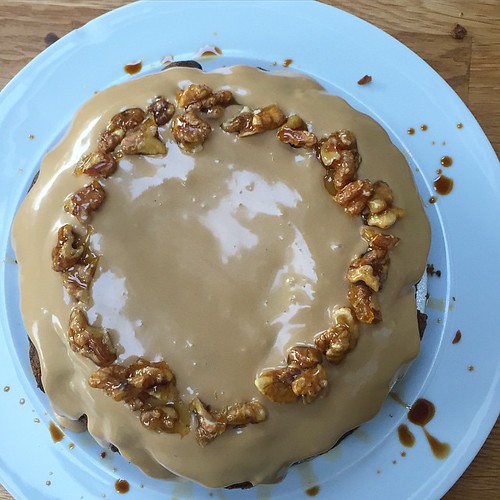
Cake! A @konditor_and_cook coffee and walnut cake.

This week’s food has been anchored around Sunday’s roast chicken. Having acquired a gruesome cold from my daughter, I had very little energy, so did no more than throw a bit of salt on it and put it into a hot oven for half an hour. I added potatoes and some chunks of sweet potato when I turned the oven down, and roasted for another hour. The bones were cooked for stock on Tuesday, and the cold chicken made into curry, and then fried rice. We’ve also been snacking all week on the coffee and walnut cake I made from the Konditor & Cook book – pictured above. Unfortunately, I’ve completely lost my sense of taste and smell with this cold, so I have no idea if it tastes of coffee or not!

Recipes:

  • Coffee and Walnut cake – Konditor and Cook (above)
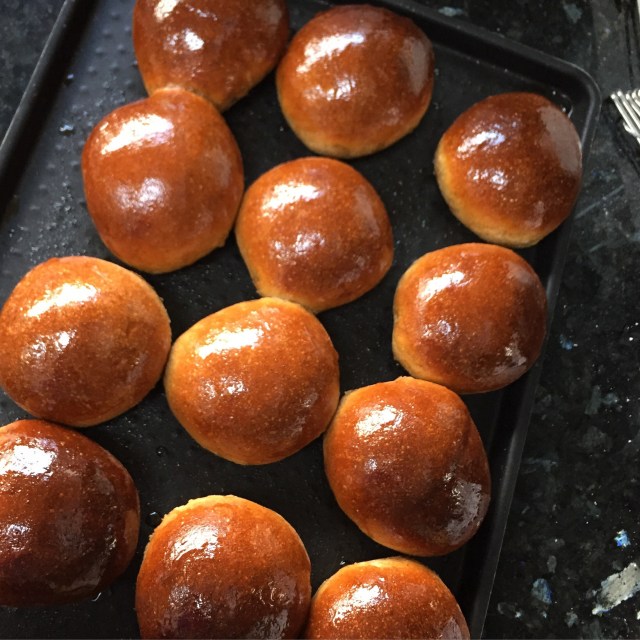
  • Hot Cross Buns (again) – this time with fruit!
  • Tarka Dal – Diana Henry’s Change of Appetite

Without a recipe:

  • Roast chicken with potatoes and broccoli
  • Chicken stock
  • Chicken and mushroom korma (Spice Tailor)
  • Charlie Bigham lasagne
  • Chicken and egg fried rice with broccoli and spinach
  • Fish curry (from the freezer)

Reading:

Friday food links – 20 Mar 2015

We’ve been living in a plague house this week. Little E became ill on Sunday, and we’ve both had milder versions of her symptoms. As it happened, we were supposed to be on holiday this week, so while we had to cancel going away, it did mean we could both be around to look after her.
So comfort food has been the order of the week: lots of eggs and potatoes in various forms.

Recipes:

Without a recipe:

  • Takeaway Byron burgers 🙂
  • Cod with potatoes, leeks and fennel, a bit inspired by @bartsfishtales on Instagram
  • Bubble and squeak

Reading:

What’s missing from a recipe

Last week I made pistachio gelato (post coming soon), a type of recipe I had not tried before. It frustrated me because it included guidance to remove from the heat “when the mixture approaches a simmer”, but no explanation of why this specific heat was needed, nor what would happen if you let it actually simmer. I like to know why I am doing what I’m doing, and in this case, the information was missing.

This is a subject that has been occupying me for some time. The current standard format for recipes was developed during the 19th Century by domestic cookery writers like Eliza Acton and Isabella Beeton. They were the first to write a separate list of ingredients, followed by the method. Before that, the instructions would be very brief, intended as a reminder for those who had already learnt about cooking from their mother or as an apprentice to a cook.

So Hannah Glasse, writing The Art of Cookery, Made Plain and Easy in 1774, could write this recipe for tart pastry:

One pound of flour, three quarters of a pound of butter; mix up together and beat well with a rolling pin.

Recipes like this were never intended to be a replacement for the teaching of cookery. They are still a very limited format. However, they are a popular one, and virtually standardised over the past 100 years, so that most people recognise a recipe layout if they see one, and know what to expect. They also work fairly well as a compromise – something that can be reproduced easily in many different media, and something that strikes a balance between too much and too little information.

However, as a teaching tool for learning to cook they definitely err on the side of too little information. Worse, because they form the main body of most cookbooks, it would be natural for those learning to cook from a book that everything you need to know would be contained in them. This is very far from the case.

It is hard to find information on which parts of the recipe are important, and which are more flexible. Where is it safe to deviate and where is it not? To compound the problem, few experienced cooks know which parts of a recipe are most important to follow. If you always follow recipes, how would you know what happens if you don’t? Or how to fix it if the recipe turns out to be wrong?

What is missing from most recipes is the context-sensitive techniques that allow you to exert your own judgement about the recipe. The understanding you need to decide if something is done, if it has gone wrong or if you should add more or less of something. By implying that the recipe contains everything, we remove people’s capability to make the adaptations that are always necessary, because the circumstances in which we cook are always unique.

In the next few posts, I am going to try and pick out the parts of a recipe that are missing, the bits to pay attention to, and those you can be more relaxed about. Hopefully, this sort of information can then be applied to any similar recipe you come across, rather than being specific to the one you’re looking at. And that sort of knowledge should be more enduring.