Cake – a quest for an everyday muffin

I’ve been in denial, but now I need to accept that I have a problem and address it. I like cake.

I make cake at home, I share it with friends. I bake birthday cakes for people. I think most of the cakes I make are better than those that I buy.

And yet, I buy far too many expensive, mediocre cakes and biscuits during the week at work.

THIS HAS GOT TO STOP.

You see, the problem is that I tell myself I don’t need cake in the week, that it’s just for dessert and occasional weekend treats. But this is not true. I eat some form of cake, biscuit or pastry every day, often twice a day. So what I should really do is make my own cakes, try and make them as healthy as I can, with whole grains and fruit in, and take them with me to work, so that I won’t buy the Paul Pain au Chocolat, the Eat Banana cake or the Pret Flapjack thing. (I might have to stick with the Leon Lemon and Ginger cake for a while, just until I figure out the recipe).

The first step then, was to bake some muffins, which freeze very happily, are very accommodating of modification, and fill that mid-morning gap perfectly.

Gordon Ramsay has a nice recipe for blueberry muffins in his ‘Healthy Appetite’ book, which uses wholemeal flour and mashed bananas, so that seemed like  a good place to start.

And then, I was reading Eggbeater, and came across this description by shuna of a muffin she had made for the weekend pastry basket at 10 Downing Street (the New York restaurant where she works):

” buckwheat-banana-walnut-coffee-candied ginger muffin”

Doesn’t that sound amazing? I knew I had to give it a go.

So I started with the Gordon Ramsay recipe and modified it. Unfortunately my modifications weren’t bold enough the first time. The coffee made the dough convincingly brown, but didn’t contribute much to the flavour. The ginger appeared when you got a nugget of candied ginger, but otherwise was quiet. So I tried again, and increased the quantities of flavouring, adding the ginger syrup, and more coffee. I ended up with a great flavourful muffin. The bitter flavours of the coffee and walnuts balance the sugar and bananas to make a not-to-sweet breakfast muffin. The walnuts and demerara give crunch and the bananas keep the whole thing moist. And I get to tell myself that its entirely healthful, so I can tuck in every day of the week.

Ginger coffee walnut banana muffins

Introduction

Based on a single line from Shuna Fish Lydon: buckwheat-banana-walnut-coffee-candied ginger muffin”.

The recipe is adapted from Gordon Ramsay’s recipe for blueberry muffins in ‘Healthy Appetite’.

This is a great breakfast muffin, because the bitter flavours of the coffee and walnuts balance the bananas and sugar to make sure it is not too sweet.

Tips

You can freeze bananas when they are ripe, even all brown, for baking with later. They will go very squashy, but that doesn’t matter if you’re going to mash them up anyway.

Flour develops gluten when it comes into contact with liquid – the protein that makes bread strong and elastic. If this develops in muffins, it makes them seem tough and chewy, so minimise the gluten by keeping the dry and wet ingredients separate until the last minute, and by then mixing gently together until they are just combined.

Ingredients

  • 2 large ripe bananas

  • 200g wholemeal self-raising flour and 100g rye flour

  • 1/2 tsp baking powder

  • 1 tsp bicarbonate of soda

  • pinch of salt

  • 100g light brown muscovado sugar

  • 1 tsp ground ginger

  • 2 tbsp of instant espresso powder dissolved in 3 tbsp of just-boiled water, or a double shot of espresso

  • 180g yoghurt and 40ml semi-skimmed milk (or 220ml buttermilk)

  • 1 egg

  • 75ml vegetable oil

  • 150g walnuts, toasted and chopped

  • 50g candied stem ginger in syrup, finely chopped (about 3 balls), plus 1 tbsp of the syrup

  • 2 tbsp demerara sugar –> to sprinkle on the top

Method

  • Preheat the oven to 180C.

  • Mash the bananas.

  • Put the flours, baking powder, bicarb, salt, sugar and ground ginger into a large bowl and combine with a whisk, to make sure the leavening is evening mixed through the flour.

  • Add the yoghurt, milk, bananas, egg, coffee, ginger syrup and oil and stir gently until just combined, but still with a couple of floury streaks.

  • Add the chopped nuts and ginger and fold in until fairly evenly distributed. Mix gently, and don’t overmix or the texture will become tough as the gluten in the flour develops.

  • Divide the mixture between 12 muffin cases in a muffin tin. Sprinkle the top of each muffin generously with demerara sugar.

  • Bake for about 20 minutes or until the tops are brown and crusted, and the top springs back. If you are unsure, test with a toothpick or skewer to check there is no liquid mixture in the centre.

  • Cool for 5 minutes in the tin, then remove the cases to a cooling rack until completely cold. Eat immediately while warm, or freeze on the same day. You can take out a frozen muffin to take to work, and it should thaw during the day (or you can help it along with a quick burst in a microwave).

A few food-related links

The wonderful Shuna writes about the balance between Recipes and Intuition:

“I believe if one places the recipe before what one knows to be true, that’s where {some of the} trouble begins.
That’s when “Bad Things Happen.””

http://eggbeater.typepad.com/shuna/2009/10/recipes-vs-intuition.html

Autumn recipes for crisps (= UK crumble)

Pear Crisp from The Pioneer Woman

Breakfast Granola Apple Crisp from Smitten Kitchen

(both are on the to-bake list)

A lovely banana bread recipe from Sophie Dahl in Waitrose Food Illustrated which I adapted slightly here.

Some lovely friends bought me a gift subscription from The Spicery for my birthday, and I’m already enjoying it so much that I’ve ordered a stack of extra things from them – including beautiful long Cinnamon quills and really fragrant garam masala. Check out the recipe kits.

Birthday cake

Chocolate - from iStockphoto

Chocolate - from iStockphoto

Birthday cakes need to be so many things: celebratory; they need to fulfill the wishes of the birthday boy or girl rather than the baker; and demonstrate an appropriate level of effort. It’s this last one that can give me trouble. While I love to make a cake, and will use any excuse to do so, it sometimes feels odd to create something really elaborate for a work colleague or boss. And besides, I don’t often have the time to go overboard. This is where the chocolate torte comes in.

Chocolate torte is one name for a soft chocolate cake made with ground almonds. Other names are Reine de Saba, or Queen of Sheba cake, or it can simply be referred to as a flourless chocolate cake.

To give some idea of the amount of variation possible, I compiled this table from books I own (oh stop: you didn’t already know I was a geek?):

Author Nigella Lawson Sybil Kapoor Gordon Ramsay Alice Medrich Elizabeth David Julia Child
Book How to Eat Taste Just Desserts Bittersweet French Provincial Cooking Mastering the Art of French Cookery
Recipe Torta alla Gianduja Catherine’s Chocolate Cake Dark and Delicious Torte Queen of Sheba Reine de Saba Reine de Saba
Butter 125g 60g 100g 140g 85g 110g
Chocolate 100g 1 cup 350g 170g 110g 110g
Eggs 6 3 4 4 3 3
Sugar 0 85g 200g 170g 85g 150g
Flour 0 2 tbsp 0 2 tbsp 0 50g
Ground nuts 100g 0 0 70g 85g 55g
Others 400g Nutella Water, brandy, coffee Brandy, almond essence Brandy, coffee Rum, coffee

As with so many of my chocolate experiments, it began with Alice Medrich’s ‘Bittersweet’. She devotes a chapter to a number of variations on this recipe, and reassures the reader that this is a recipe that will accommodate, even welcome changes. She provides us with that elusive license to create almost infinite experimental variations, and still produce an edible result. There can be few experienced home cooks who don’t read through a recipe and mentally edit it. However, we are often admonished that one really ought to follow a recipe to the letter the first time, so you can understand the starting point. While that remains good advice, the freedom to add your own stamp right away is a great inducement to try this recipe. So here at last is a recipe that you can rearrange and make your own, and still produce something that everyone will be happy to eat – and provides a suitable celebration cake at the same time.

Chocolate torte:

Prepare a 20cm/8 inch springform or loose-bottomed tin, by lining the base with baking parchment.

150g dark chocolate (I used 64% Valrhona Manjari)
150g butter

–> melt together, and stir until smooth

1 cup espresso (I used about 1/2 tbsp instant espresso powder in enough water to just dissolve it)

2 tbsp brandy

–> mix into melted chocolate, and set aside

100g ground almonds

45g flour

–> measure and mix together

4 large eggs

–> separate into yolks and whites. If you have a stand mixer, use that bowl for the whites.

110g sugar

–> combine with the yolks and beat until well blended (you can do this by hand, or briefly with a machine)

–> stir in the melted chocolate to combine.

–> separately, whisk the egg whites to soft peaks

50g sugar

–> whisk in 50g sugar to make a meringue, and continue whisking until you have stiff peaks.

–> Fold the whites into the chocolate mixture, by first adding one-quarter, and thoroughly beating it in, then folding in the remainder.

–> Bake for around 30 minutes at 190C/375F, or until a skewer inserted about 4cm from the edge comes out clean, but one inserted in the centre is still gooey.

Hazelnut Brownies

Brownies are disproportionately easy, relative to the joy they bring. They feel much more special than an ordinary ‘traybake’ cake, but are as easy as a cake mix to put together. The basic principle is this: melt chocolate and/or cocoa with butter; beat in sugar and cold eggs; beat in flour, turn into pan; bake. That’s it – if you’ve got a microwave, you can do the whole lot in a single bowl.

I’ve been refining my brownie recipe over several years – it’s easy to do, because it’s such a forgiving recipe. Alice Medrich’s recipes in Bittersweet give almost every variation, dedicating a whole chapter to a nearly-forensic analysis of brownie baking. The version below is an amalgamation of her cocoa and chocolate brownie recipes, with some changes. I’ve also uprated the recipe from the usual 8 x 8 inch tin to a larger 12 x 9 tin: you can never have too many brownies.

Alice Medrich supplied many of the tricks here: it is her testing that indicates you should use cold eggs, and that the mixture should be beaten firmly after adding the flour; I am choosing not to re-invent the wheel. She also has a very useful trick of refrigerating brownie batter in the tin for up to 24 hours before baking. Not only does this make it possible to produce just-baked brownies within half an hour, but it makes the brownies even fudgier.

Frangelico is a pretty obscure liqueur, but I have to say, it makes all the difference to this recipe, giving a toasted, fragrant nut flavour to the whole thing. That said, the recipe makes perfectly good brownies if you don’t want to go to the bother of searching it out. You can also substitute the carefully toasted nuts with a packet of roasted (unsalted) mixed nuts from the supermarket.

Ingredients:
170g butter
55g cocoa
130g chocolate (combination of dark (70%) chocolate and milk chocolate)
40g chocolate & hazelnut spread (Nutella, Green& Blacks)

300g caster sugar
2 tbsp Frangelico (hazelnut liqueur) – or 1.5 tsp vanilla extract

3 cold eggs

105g flour
1/2 tsp salt
150g hazelnuts, toasted

Method:
Line a 12×8 inch tin with baking parchment or foil.

Melt the butter, cocoa, chocolates and chocolate spread together – use a microwave in short bursts or a bowl over a pan of barely simmering water. Stir together until smooth.

Stir in the sugar and Frangelico (if using) until thoroughly mixed.

Beat in the eggs, one at a time.

Fold in the flour with the salt, then beat firmly until the mixture is glossy and pulls away from the side of the bowl a little (about 30 stiff beats). Mix in the nuts.

Scrape into the lined tin. Bake at 200C for 20-25 minutes or until the mixture just begins to pull away from the side of the pan. Wait until completely cold before slicing (if you have the patience…)

Marbled Cupcakes

Marbled chocolate cupcakeHaving promised to make dessert for friends who were giving us lunch on Sunday, I found myself able to indulge in one my chief cooking pleasures: picking something to bake from my capacious cookbook collection. My first thoughts were for a strawberry tart, something that characterises early summer. But as the week wore on, and it got windier and wetter, I felt that something comforting and chocolately would fit the bill. I ended up with Alice Medrich’s ‘Bittersweet‘, which has chocolate recipes for every occasion you could think of. I was lucky enough to attend one of Alice’s classes in California; she combines a great depth of knowledge about chocolate with an infectious curiosity. This comes across in the recipes, which are suitable for the most elevated occasions, but also detailed and reliable: which is one reason why I felt comfortable breaking the rule that you should never try out a new recipe for the first time on guests.

Molten Raspberry-Chocolate Cupcakes with Marbled Glaze

adapted from ‘Bittersweet: Recipes and Tales from a life in chocolate’ by Alice Medrich

Note: I used the cup measures that Alice specifies in the book when I made them. I have given conversions to metric, but haven’t checked these, so be warned. I’ll test these out next time I make this recipe.

  • 1 cup plain flour (140g)
  • 1/2 cup cocoa powder (50g)
  • 1/4 teaspoon baking powder
  • 1/4 teaspoon bicarbonate of soda
  • 1/2 teaspoon salt
  • 1/2 cup seedless raspberry puree (125ml) (1 punnet raspberries, pureed and sieved)
  • 3 tablespoons brandy or rum (I was stuck here, so used 1tbsp Grand Marnier, 1tbsp vodka and 1 tbsp water)
  • 1 teaspoon vanilla extract
  • 10 tablespoons butter (145g)
  • 1 and 1/3 cups caster sugar (300g)
  • 3 large eggs

For the chocolate glaze:

  • 6oz dark chocolate, 65-70% (170g)
  • 8 tbsp butter (115g)
  • 1 tbsp corn syrup (there’s not really a good substitute for this as far as I know – but some supermarkets stock it)

For the marbling:

  • 1 oz white chocolate (25g)

Preheat the oven to 350F/180C. Prepare a muffin tin with paper cases or grease the moulds. This makes about 18 muffins; I made 12 muffins and 2 little cakes in some 4″ pie dishes.

Thoroughly mix the flour, cocoa, baking powder, bicarb and salt in a bowl. Sift onto a sheet of greaseproof paper to help mix and get all the lumps out of the cocoa. This also gives extra lightness to the sponge.

Combine the raspberry puree, brandy and vanilla in a small bowl or jug. This will be quite liquid.

In a medium to large bowl, or the bowl of a stand mixer, cream the butter (*much* easier with electric assistance). Add the sugar gradually while you continue to beat the butter. Once all the sugar is in, continue to beat for 4 or 5 minutes – it should be really pale and fluffy. Don’t shortcut this part – it gets all the air in.

Break the eggs into a bowl or jug and whisk just to combine the yolks and whites. Add to the butter and sugar in a trickle, while continuing to beat. Adding it slowly prevents the mixture from curdling, but if it goes ahead and curdles anyway, don’t worry – it will mean slightly less air in the mixture, but it’ll still turn out OK.

Stop the mixer, and add one third of the flour mixture from the paper. Mix just to combine, then add half the raspberry mix and mix again. Alternate the flour and raspberry until everything’s combined. Be gentle, to keep all the air in that will help the mixture rise.

Scrape the batter into the pan or spoon into the muffin tins. Bake for 20 minutes, until the mixture pulls away from the side of the tin, and a skewer inserted in the centre comes out clean. Cool on a cake rack. (You can store the cakes in an air-tight container overnight at this point, or freeze).

While the cake cools, make the glaze: melt the chocolate, butter and corn syrup together over simmering water, or in the microwave, stirring until smooth. Melt the white chocolate at the same time in a separate bowl. Cool the glaze until it is thickened but still pourable, then dip the top of each muffin into the glaze. While the glaze is still wet, dip a teaspoon or skewer into the white chocolate and drizzle randomly onto the glaze. Use a skewer or toothpick to drag lines through the chocolate and create the marbled effect. I found it easiest to dip 3 muffins before decorating with the white chocolate. Leave the glaze to set.

Bad-tempered Cookies

It’s quarter to midnight and I’ve just finished mopping tomato ketchup off the floor. Cookies are a nightmare. No really. I’ve had it up to here.

I was a fool. I read Adam’s enthusiastic, nay, evangelical posts about Martha Stewart’s cookie recipe and I had to give it a go. More fool me. Firstly, the recipe needed to be translated from the dreaded American cups. American cups as a baking measurement are just infuriating – for some reason the good old US of A refuses to use scales while baking, just as they cling to pounds and inches. Cups are never the same weight twice, especially when you’re talking about something like flour. Then there’s the ingredients. American All-Purpose Flour is actually somewhere between Plain Flour and Strong White Flour, and American granulated sugar is not as coarse as British granulated but not as fine as caster sugar.

So I took Adam’s recipe, and measured it carefully, substituting approximate British equivalents and … just look what happened:

Isn’t that the ugliest batch of cookies you’ve ever seen? The first set were gigantic and undercooked in the middle, the second and third batches better, but still ugly, the third set I burnt (those ones in the lower right-hand corner aren’t actually double chocolate – they just got baked for half an hour!).

Maybe it wasn’t the cookies after all – maybe they were just a karmic sign, because just after I pulled out the last baking tray, this happened:

You see, all week I’ve been avoiding a couple of kitchen chores: to scrub the kitchen floor and to wash down the skirting boards and door frames in preparation for painting them this weekend. The Ketchup Disaster ensured that I had to wipe down the skirting boards, and walls, and mop the floor. So maybe the cookies were just a sign after all: don’t waste your time on frivolous baking projects, get on the floor and clean, damn you!

So it’s Jeffrey Steingarten’s cookie recipe next – let’s hope I find a better time to try it, karmically-speaking.

Technorati Tags: ,

No-knead Bread


No-knead_bread
Originally uploaded by louise_marston.

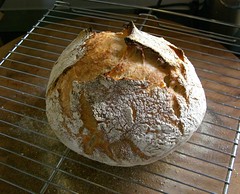
Like the rest of the blog-o-sphere, I have been trying out Jim Lahey’s No Knead Bread recipe over recent weeks. This was first published (with video!) by Mark Bittman in the New York Times, and has since gone several times around the world via various blogs. I took the precaution of using Clothilde’s translation to grams, rather than those unreliable cups, having heard some reports of failures. This is my fourth go with it, and I have found it a very reliable recipe, consistently rising high and developing a very lovely crust. I have also combined it with some sourdough starter to get a slightly sour loaf. I am particularly enthusiastic about it as something that I can realistically tackle during the week, in just the time I have after work, between cooking dinner and eating dinner.

European No-Knead Bread
470g plain flour (I usually use half plain and half bread flour)
350g water = 350ml
10g salt – about 1.5 tsp
1/4 tsp yeast

Mix the salt and yeast into the flour in a large bowl so they are evenly distributed. Pour in the water and mix with your fingers just until you get a single doughy mass that pulls away from the bowl. Then stop. Scrape your fingers off, and cover the bowl with cling film or a tea towel, and leave on your kitchen counter for 12-18 hours. I have left it for 20 hours in a cool kitchen and it was fine. You can make this last thing at night and return to it the next day after work.

Scrape the dough out of the bowl with a spatula, onto a floured worktop. Press the dough down with your fingertips and fold the left side over one third, then the right (like folding a letter). Flatten the dough a little again and fold top to bottom in the same way.

Sprinkle a teatowel with flour and some cornmeal/polenta or wheat bran if you have it. Place the down seam side down on the towel, and fold the edges over it. Leave for 2 hours to rise again. After an hour and a half, take a Pyrex or cast iron casserole dish with a lid, and put it into the cold oven. Heat it as hot as it will go – as close to 250C as you can.

After the 2 hours are up, take out the casserole, use the towel to tip in the dough (you don’t have to be too delicate) and put the hot lid back on. Return to the oven for 30 minutes, then remove the lid and bake for 15 more minutes to brown the top and develop the crust further.

Then take it out and tip onto a wire rack. Allow it to cool before slicing – and eating with lots of butter!

Bread to be proud of

Sourdough

A paste of ground wheat and water. Yeasts from the air land on the surface and start to grow and multiply. The yeast consumes the sugars from the wheat, and produces carbon dioxide. Bubbles appear. Bacteria also start to colonise the paste, feeding on other sugars that the yeast does not consume.

This dual colony grows, produces lactic acid, produces carbon dioxide. More flour is added, more water, a dough is made. The proteins in the flour join to make a long protein, which is developed by working the dough. it is stretched away, pulled back, turned. The surface becomes smooth, stretchy, soft. The yeast trapped within the proteins keeps growing, producing carbon dioxide. The bacteria keep growing, keep producing lactic acid. The dough swells, becomes puffy, pillowy. It is moulded, shaped, the surface tightens, dries. The dough is put into the warm oven. The yeast grows faster, the gases expand, the dough stretches. And then, the heat is higher, the yeast dies, the protein sets and stiffens. Moisture in the oven gelatinises the starch, creates a stiff shiny exterior. The starch caramelizes, browns, darkens.

And you have a loaf of bread. Just as the Egyptians would have made, just as the goldminers made in California, just as the French have been making for centuries. And it tastes good too.