Friday food links – 18 Sep 2015

Borlotti beans for dinner tonight - when they will look a lot less pretty than this 😕

This week has been patched together, bits and leftover pieces stretched and sewn at the edges to fit as much as possible. E has been sick, and sleeping poorly as a result. This means staying home, going to bed early to comfort her, sitting with her while she naps – and then trying to fit in all the business of the week in the little gaps. So lots of planned things went out the window – including work! And a few day’s dinners were downgraded to simpler options to fit in. This week has, perhaps appropriately, been Jamie Oliver-themed. I don’t think any other British cook has put as much effort into getting interesting weeknight dinners on the table. I’ve made a recipe from the new Jamie Oliver Superfood series, and bookmarked the fish tacos for this weekend. I haven’t bought the book yet, but I’m tempted.

Recipes:

Without a recipe:

  • Vegetable korma – with a Spice Tailor sauce
  • Various leftovers for other meals – curry and rice, courgette parmigiana with leftover beans.

Reading/Listening:

Friday food links – 14 Aug 2015

White bread, wonky stripes

A warm but rainy week means alternating between summer food and something comforting. So sweet corn, salsa, courgettes, tacos but also vegetable chilli, roast chicken and gratin. I’ve also been enjoying a couple of new cookbooks. The first is one I’ve bought: Food52 Genius Recipes. I’ve linked here before to the Genius Recipes column on the Food52 website, and this collection of recipes gives you something new to learn on almost every page, even for experienced cooks. By choosing the surprising and unusual recipes, the ones that seem to break the rules but still produce great results, they’ve produced a very different sort of essential recipe collection.

The other book is the Momofuku cookbook, borrowed from the library. I don’t often buy restaurant cookbooks. By their nature, the recipes tend to be complicated, multi-step affairs, that I’m unlikely to want to attempt at home. But I’ve been reading this mainly for David Chang’s great essays on learning to cook and setting up a restaurant. As I knew from reading his food magazine, Lucky Peach, David knows how to write engagingly about food. And he’s an honest and humble documenter of his food journey. I may even try out some of the recipes from here too.

Recipes:

  • Gratin of courgettes and rice – Food52 Genius Recipes
  • Plum torte – the same
  • Bircher muesli – approximately from Felicity Cloake. I soaked in apple juice and water as we were out of milk.
  • White bread from Brilliant Bread

Without a recipe:

  • Pasta with sausage, cherry tomatoes and courgette
  • Vegetable chili with black beans
  • Fishfinger tacos with tomato, corn and avocado salsa
  • Roast chicken with roast veg

Reading:

Soft set strawberry jam

Strawberry jam

I have a very neglected strawberry patch. When we first changed our garden to create space to plant vegetables, I planted five Cambridge Favourite strawberry plants along with the lettuces and tomatoes. Since then, I have been very inattentive and have let them multiply all over the place until they take up a good third of the growing area. This year, because of pregnancy and baby, I have been particularly neglectful, but despite that, and the efforts of some greedy local wood pigeons, there has been a bumper crop.

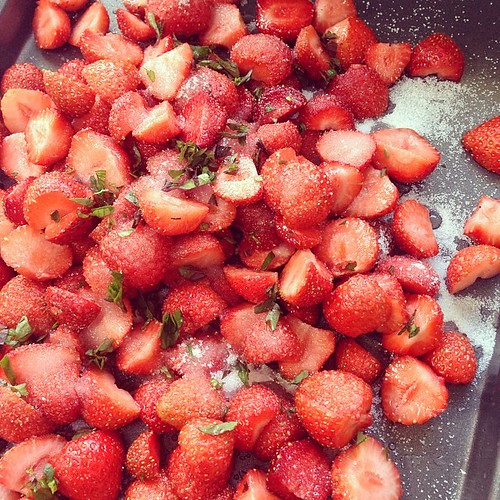
Strawberry-mint syrup underway for @JenniferPerillo roasted strawberry frozen yoghurt

I put the first batch into roasted strawberry syrup and strawberry frozen yoghurt, following Jennie’s recipes. Then as another batch started to look neglected in the fridge, I knew the only way to hang onto their fragrance and flavour was jam.

Strawberry jam

Strawberry jam has a particularly tricky reputation. This is because strawberries contain very little pectin, the sticky substance that makes jams thicken, and so need lots of encouragement to set. It’s easy to end up with strawberry soup, which slides and drips off scones and toast. To combat this tendency, recipes typically include lemon juice, lots of sugar and added pectin, either from a bottle or using jam sugar.

I wanted a fresh tasting jam, without excessive boiling, and something I could do quickly (babies require you to shorten all tasks as much as possible). Many recipes ask you to macerate the fruit and sugar overnight, so they were out. I decided on Kim Boyce’s recipe in ‘Good to the Grain‘. This one is unusual in a few ways. First, it asks you to cook the sugar with water into a syrup before adding the fruit. My guess is that this allows you to cook the berries for a shorter time. It also contains much less sugar than other recipes: a cup for 3 lbs of fruit (or 230g sugar to 1.3kg fruit).

I liked the idea of this recipe, but was a bit scared that it would produce a soup, so I made the following changes:
– although I had only 900g (2lbs) fruit, I kept the sugar quantity the same
– I added the juice of half a lemon
– I then chopped the rest of the lemon half into slices and boiled it in water with the pips for 10 minutes. I then strained this into the pan with the berries.

This is a quick way to extract some pectin, and if you have more time, can be done more thoroughly, with the pieces squeezed through muslin (see marmalade post). This is loosely adapted from a June Taylor method, and a Christine Ferber recipe. As well as helping the set, I find adding lemon to strawberry jam really lifts the flavour, and prevents it from being cloying. (Felicity Cloake agrees).

[to see how effective this approach can be, when you have a lot of lemon pips, put them in a bowl and cover with cold water, and leave them to stand. The water will likely gel as the pectin coating the pips dissolves in the water.]

Strawberry jam

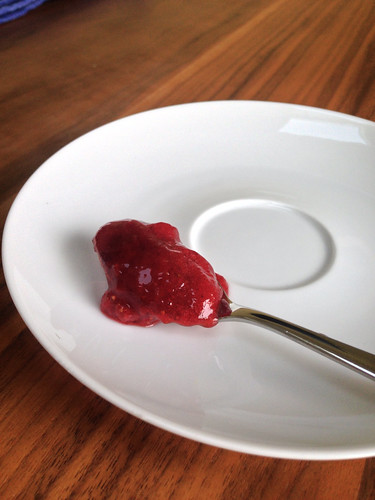
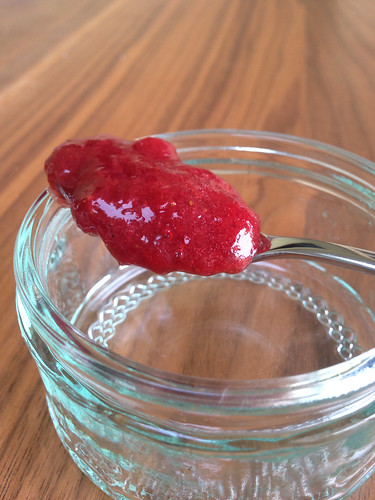
After boiling for 15-20 minutes, the mixture reduced down to a thick bright-red syrup, and after testing for a set, I took it off the heat. I then added a final lemon flourish by zesting the remaining lemon half straight into the jam before putting into jars.

This does not produce a remotely stiff jelly, and is a decidedly spoonable consistency that needs to be kept in the fridge. But the bright colour and flavour are enough to convince me to try this approach again when strawberries come around next year.

Strawberry jam

Recipe: Soft set strawberry jam

adapted from Kim Boyce ‘Good to the Grain’, an inspiring book of recipes for unconventional flours and grains

  • 900g strawberries
  • 240g sugar
  • A lemon

Wash and hull the strawberries. Cut most of them in half, leaving the tiny thumbnail sized ones whole, and cutting the big monsters into quarters. The berries will break down as they cook, so the pieces don’t need to be small.

Halve the lemon, juice one half and reserve, and slice the empty half into thin pieces. Put into a small saucepan with any pips, cover with cold water and boil for about 10 mins to extract the pectin.

Put a couple of saucers or small plates in the freezer to check the set later on.

Place the sugar into a large saucepan or preserving pan and add about 100ml water. This is the pan you will make the jam in, so it needs enough room to allow the jam to bubble up (minimum of 4 litre capacity). Put on a medium-high heat and bring to the boil to dissolve the sugar. Swirl the pan occasionally to ensure the sugar crystals all dissolve, and to make sure there are no hotspots where the sugar could start to caramelise.

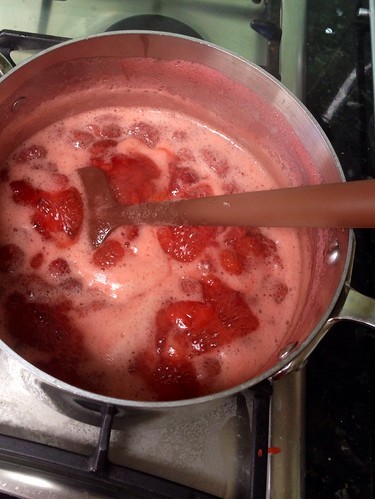
Once the syrup is clear and bubbling, add the strawberries, lemon juice, and strain in the water from the lemon half, pressing down on the solids. If you have time, you can cool these pieces and put into muslin and squeeze it to extract even more pectin.

Bring everything to a rapid boil, turning the temperature down if it threatens to boil over. Stir occasionally to make sure nothing is sticking to the bottom. The mixture should reduce down and thicken. When it seems thick, take out a spoonful onto one of the cold saucers or plates. Leave it in the fridge for a minute or two, and take the pan off the heat. When you push the side of the blob of jam with a finger, you should be able to see wrinkles on the surface, which indicate a set. Mine reached 102.5C with a thermometer when I took it off the heat (usually you look for 104C for jam to set, but as this has little sugar, and sets softly, it won’t get there).

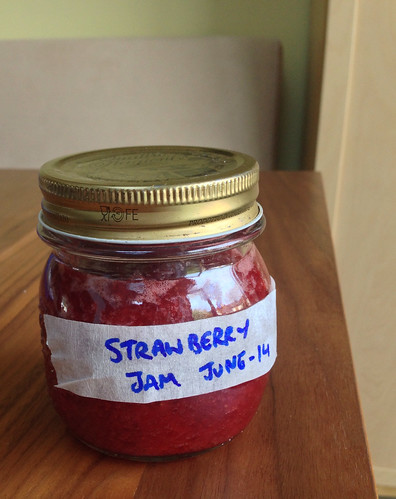
With the jam off the heat, zest in the remaining lemon half and stir in. Allow the jam to settle and thicken a little in the pan before putting into clean, sterilised jam jars. As this has so little sugar, it should be kept in the fridge.

Seville orange marmalade

Untitled

I have made marmalade a number of times, with some notable successes as well as notable failures. I have had everything from a dark brown orange syrup to a set so thick you could bounce things off it. No one seems to have the same recipe, and several of them flat-out contradict each other. Nigel Slater, in the Kitchen Diaries II, at least acknowledges that every marmalade maker has their own peculiarities and that none of them can agree.

Marmalade making requires getting three things right: enough pectin in the mixture to create a gel; a balance of sugar, acid and pectin that will enable the gel to set at room temperature; and cooking the peel through enough to make it edible and not too chewy. There are a huge number of routes that you can take to get to this end result, and most regular marmalade-makers will have a preferred route, as well as desired result. Some are aiming for a tawny, caramel-tinged, dark marmalade with hearty chunks; others a light, clear jelly with threads of peel through it.

My real conversion to marmalade making was discovering June Taylor’s approach. Although recipes from her are frustratingly hard to track down, her handmade approach and attention to detail have produced stellar results when I have tried them – a softly set bright orange jelly with an amazing fresh flavour. This comes (I think) from a much lower-than-normal amount of sugar in her recipes, as well as a time consuming process which involves segmenting the fruit, and removing the membranes into a bag with the pips, so they can contribute pectin, but not cloud the jelly.

With marmalade, you have to balance the simplicity of making it with your satisfaction with the end result. How far are you willing to go? If you’re ready to make your own marmalade, we can safely assume you’re willing to go quite a long way, but segmenting each orange is a very different amount of active effort needed, compared to boiling the fruit whole and then chopping it all up. But for me, it comes down to how happy I will be with the end result. I am almost incapable of throwing away food that I have spent large chunks or time or money preparing, so if I end up with 5 jars of not-very-good marmalade, I know from experience that they will sit in the cupboard for a long, long time while I reluctantly work my way through them. If they are not great, I won’t want to give them away either, making their stay in the cupboard even longer.

I would rather spend an extra half hour on preparation to end up with a sparkling result that I’m incredibly proud of and can’t wait to share with other people. That, to me, is a much better reward for my time than a few jars of dark and muddy orange-flavoured jam.

Having tried a tangerine and grapefruit recipe before, with good results, I decided to try and work out what a June Taylor-style Seville orange marmalade recipe might look like. This was a tricky task, as she doesn’t make Seville orange marmalade at all – it’s one of very few citrus fruits that you never see in California. So I read through quite a few alternative approaches, as well as some blog entries that had also attempted to replicate her approach, to see if I could come up with something appropriate.

I started with her recipe for Thick cut orange marmalade, published in the San Francisco Chronicle. However, as this was a recipe for the thinner-skinned, juicier sweet oranges, I felt that I would need to modify it somewhat. One of the things I particularly liked about the tangerine and grapefruit recipe is that you get to slice across the segments, creating juicy chunks of citrus flesh with peel attached, which survive into the finished jam. However, doing this for all the oranges seemed like it would both take too long and leave me with way too much peel in the final result. I have tried making marmalade with whole oranges before (the method where you boil them whole, and then chop them) and have found that with the thick peels, you get far too much peel for my liking.

So I took a hybrid approach, slicing one lemon and one blood orange in segments with the skin on, and removing the peel before segmenting for the Seville oranges. As I did this, I removed the (copious) pips and, on Dan Lepard’s advice, popped them straight into a small dish of water. By the time I had finished the fruit preparation, this little bowl had gelled solid, demonstrating just how much pectin there is in those pips.

The final fiddly thing I did was to take the pieces of orange peel, and blanch them. I’m sure this stage is not essential, but I thought it worth doing for two reasons: one, when making candied peels, you are almost always asked to blanch the peel, sometimes repeatedly, to ‘remove bitterness’. I thought the same thing might apply here. It would also give them a headstart on softening, making it easy to slice them, and ensuring that I could cook the rest of the mixture for a fairly short period – something that’s important if you want to preserve a fresh, citrus flavour rather than aiming for a caramel one. So these were blanched, drained, about half of them sliced finely and added to the fruit. I kept the rest back to make candied peel with.

Candied orange peel

Recipe: Seville orange marmalade

This does make a rather acidic marmalade – something to really wake you up. If you are partial to chewing pieces of candied orange peel, it should be right up your street. If you prefer a sweeter marmalade, you may want to increase the sugar.

  • 1.5 kg Seville oranges (I ordered mine from Riverford organics)
  • 1 lemon
  • 1 blood orange (not essential – I happened to have one leftover)
  • 1.7kg of fruit in all
  • 600ml water
  • 750g granulated sugar

Segment the blood orange and the lemon, with the skin on and slice thinly.
Top and tail the seville oranges. Slice off the peel taking as little pith with it as possible. Then slice off the pith, exposing the flesh. Collect the strips of pith in the muslin. Segment the Seville oranges, removing the pips into a small bowl of water as you go. Squeeze any juice from the membranes that are left into the same bowl as the segments and the sliced segments, and then add the membranes to the muslin with the pith.

First boil

Take the strips of peel and cover with cold water in a medium saucepan. Bring to a boil for 2 minutes, and then drain and cool.
Slice about half of them into thin strips and add to the juice and segments.
Leave overnight.

The next day, wash your jam jars thoroughly (or put them in the dishwasher) and then place into a 110C degree oven to keep warm. Wash the lids at the same time, but leave them out of the oven.

Add the pips to the muslin, and their soaking water to the fruit in a preserving pan. Tie the muslin up with string and suspend it in the pan. Bring everything to a boil for about half an hour, to make sure the peel is really tender. It should be possible to mash it between finger and thumb. Take off the heat and remove the muslin bag. When it is cool enough to handle (after about 30 minutes), squeeze it out to release the pectin and add into the pan of fruit. You need to squeeze and massage this for a good few minutes to extract as much pectin as possible. This takes some time, but is strangely satisfying.

Pectin from pips

When you have squeezed out all the pectin you can, add a candy thermometer to the pot, add the sugar and bring back to a boil. Stir occasionally until the sugar has dissolved (it will stop making a scratchy noise on the pan as you stir) and then let it bubble quite fast until it reaches 105C on the thermometer, then test for a set.
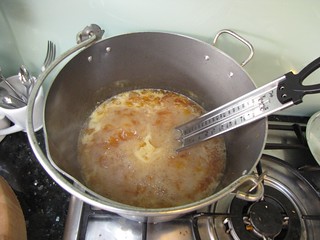
Boiling with sugar

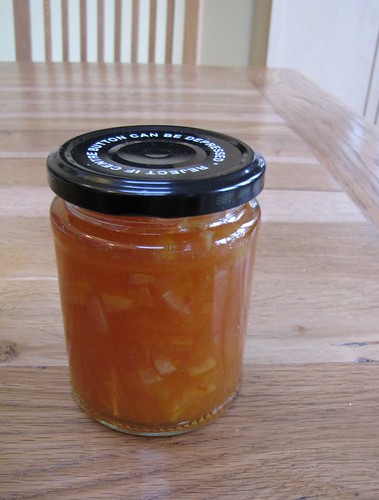
Pour the whole lot immediately into a Pyrex jug, and then into the hot jars. Using a tea towel, screw on the lids and inverted each jar for five minutes before returning them to the right way up to finish cooling. This helps to ensure the lids and surface are sterilised and prevents anything growing on the surface.

Blood Orange Marmalade


marmalade.JPG
Originally uploaded by louise_marston.

I have something of a glut of citrus fruit at the moment, courtesy of my weekly organic box from Abel and Cole, so my thoughts turned to marmalade. Although traditionally made with the sour Seville orange, it is also possible to use sweet oranges, especially if you up the acid and pectin content by adding lemons to the mix.

Marmalade is nothing more than orange jam, but the traditional recipe, originating in Dundee, requires two particular things – the afore-mentioned Seville orange, and finely or thickly sliced orange zest. The word marmalade comes from the portguese marmelada, which originally described a quince jam something like quince cheese or membrillo. Like quinces, citrus fruits are rich in pectin, the substance that sets jams and jellies into that particular firm and quivering consistency.

Basic marmalade principles are the same as those for other jams:
• Extract the maximum pectin. This is usually done by gathering the pips from the fruit, sometimes also the pulp and pith, in a muslin bag and boiling it with the juice before removing it and squeezing the bag to extract the soluble pectin.
• Ensure there is plenty of acid. This helps to extract the maximum pectin and gives a better set. Extra lemon juice is often used for this, but it’s not a particular problem for marmalade.
• Dissolve sugar completely before bringing the fruit and sugar mixture to a boil. This helps to prevent crystallisation

The aim is to extract pectin, and then to make a 60-65% sugar solution with the fruit by boiling off the water until this setting point is reached. I based this recipe on one for Sweet Orange Marmalade from Waitrose Food Illustrated magazine, adding a step to increase the pectin, as suggested in other recipes.

2 lemons
2 small pink grapefruit
9 blood oranges
500g granulated sugar

Zest the lemons, one grapefruit and 3 of the oranges using a vegetable peeler to remove just the zest. Finely julienne the zest.

Juice all the fruit. There should be just over 1 litre.

Add the pips, pith and remaining flesh from the fruit into a square of muslin. Add this to a pan of water and boil for 45 minutes. Leave to soak overnight.

The next morning, squeeze all the pectin from the muslin and add with the water to the juice, zest and sugar in a large pan. Heat gently to dissolve the sugar, then bring to a simmer and boil for 1.5 hours, or until temperature reaches 104 degrees C. Start testing the set on a cold saucer, looking for a wrinkle on the surface when it is pushed.

Let cool for 15 minutes or so before putting into sterilised jars (this helps make sure all the zest doesn’t float to the top).

This looks beautiful, and is quite tart because of the grapefruit. It’s possible that it would have benefited from the zest being blanched before adding to the marmalade to remove some of the bitterness.

Technorati Tags: , ,